Tanks vs. Drones: How Armor Doctrine Has Changed
· By Archivo Bélico editorial team
Why the war in Ukraine has transformed how tanks are used, what vulnerabilities drones have exposed, and why the tank hasn't disappeared after all.
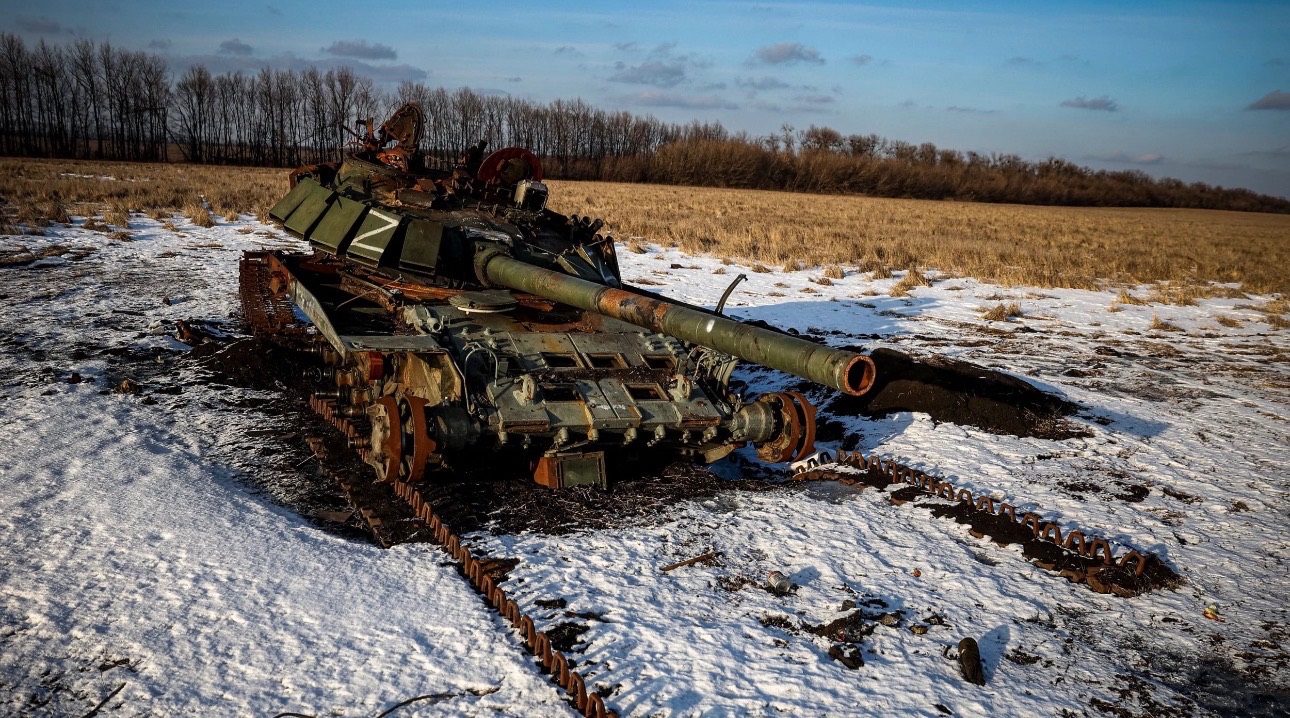
Since 2022, few military debates have recurred as often as the one about the tank's future. Footage of tanks destroyed by cheap FPV drones has fueled the claim that heavy armor is obsolete. Most analysts read it differently: what has changed is not the tank's usefulness, but how it can be employed and the price paid for moving it without protection.
An old debate with new arguments
The "death of the tank" has been announced several times before: after the 1973 Yom Kippur War with guided anti-tank missiles, in Lebanon in 2006, and in Nagorno-Karabakh in 2020 with loitering munitions. Each time the response was adaptation, not the system's disappearance. What's new in Ukraine is scale and cost: not a missile worth tens of thousands of euros, but drones costing a few hundred, built by the thousands.
What vulnerabilities the war in Ukraine has exposed
- Top armor, traditionally the thinnest, is now exposed to attacks from above.
- Battlefield transparency: constant aerial reconnaissance makes it hard to mass armor undetected.
- The detect-to-engage chain has shrunk to minutes, penalizing any prolonged halt.
- Vulnerability now extends to the rear: assembly areas, workshops and resupply columns.
- Dense minefields combined with drones turn a breach into a death trap for columns.
RUSI's reports on the conflict's lessons and Oryx's verified visual tallies have documented very heavy armor losses on both sides. It's worth noting that a large share of those losses is attributed to mines, artillery and anti-tank missiles, not only drones; blaming everything on the drone is a frequent oversimplification.
How employment doctrine has changed
In practice, employment has shifted from massed armored assault toward more cautious use. Tanks now often act as direct-fire artillery from defilade positions, support infantry attacks from a distance rather than leading them, move in very small groups with strict exposure windows. Preparing an assault now includes electronic warfare to jam drone links and, increasingly, very-short-range air defense escorting the columns.
| Aspect | Previous doctrine | Practice observed in Ukraine |
|---|---|---|
| Concentration | Armored mass for breakthrough | Small groups, limited exposure |
| Role in the assault | Spearhead | Direct fire support for infantry |
| Protection | Frontal and reactive armor | Armor plus nets, cages and electronic warfare |
| Main threat | Anti-tank missile and other tanks | Mines, artillery, FPV drones and loitering munitions |
Technical responses underway
The most commonly cited lines of work are active protection systems capable of intercepting incoming projectiles —Israel's Trophy is the most mature—, their adaptation to slow, top-attack threats, onboard electronic warfare, physical protection against top attack, and integrating short-range air defense weapons into armored units. None of these solutions is complete, and all of them make already expensive vehicles more expensive and complex.
Has the tank disappeared?
No, and both Ukrainians and Russians keep using them and asking for more. The tank remains the only platform that combines direct firepower, protection and cross-country mobility, something no drone replaces when ground has to be taken and held. What does seem to be over is the idea of armor advancing en masse across open ground without air-defense cover or electronic warfare support.
Frequently asked questions
- Are tanks obsolete?
- Most analysts say no: they remain the only platform combining direct fire, protection and mobility, but their use now requires anti-drone cover and electronic warfare.
- What destroys the most armor in Ukraine?
- Documented losses are spread across mines, artillery, anti-tank missiles and drones; attributing them solely to drones is an oversimplification.
- What defenses are being developed?
- Active protection systems like Trophy, onboard electronic warfare, top-attack protection and very-short-range air defense accompanying the columns.
Sources and references
- RUSI, analysis and tactical lessons of the war in Ukraine
- IISS, The Military Balance (recent editions)
- Oryx, visual tally of equipment losses in Ukraine
- Robert M. Citino, *Armored Forces: History and Sourcebook*, Greenwood Press, 1994.
- CSIS, analysis on the evolution of armored systems and the drone threat