
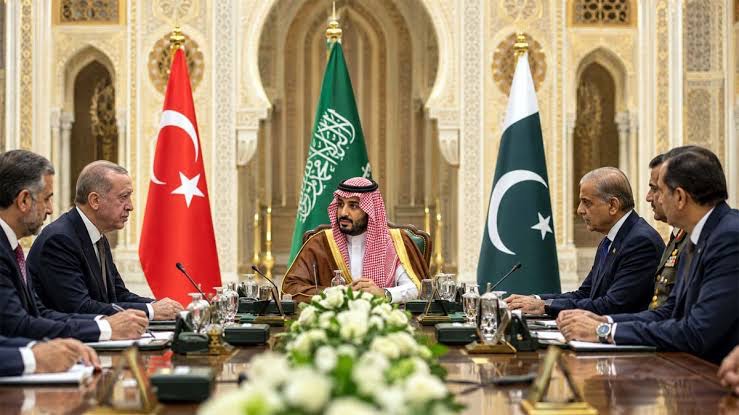
Pakistan, Turkey and Saudi Arabia: An Alliance in the Making
· By Archivo Bélico editorial team
What is known about the military rapprochement between Pakistan, Turkey and Saudi Arabia: the 2025 defence pact, Turkey's defence industry and the alliance's limits.
In September 2025, Saudi Arabia and Pakistan signed a mutual defence agreement in Riyadh whose published text states that an aggression against one country will be considered an aggression against both. The pact, announced by both governments, is part of a broader rapprochement that includes Turkey, whose military ties with Pakistan have been tightening for years. This article explains what is known with certainty, what analysts attribute to each actor and what remains speculation. As this is a developing topic, claims are attributed to their sources and the information may become outdated.
What is confirmed: the 2025 Saudi-Pakistani pact
On 17 September 2025, Saudi Crown Prince Mohammed bin Salman and Pakistani Prime Minister Shehbaz Sharif signed a 'Strategic Mutual Defence Agreement'. According to the official joint statement, the agreement establishes that any aggression against either country will be considered an aggression against both. The signing came days after Israel's strike on Hamas targets in Doha (Qatar), which analysts cited by Reuters and AP identified as a factor of urgency for Gulf countries concerned about the reliability of the American security umbrella.
Saudi-Pakistani military cooperation is not new: Pakistan has maintained military personnel in the kingdom in training and advisory roles for decades, and Pakistani contingents have been deployed in Saudi Arabia at several points in history. What is new, according to analysts, is the formal and public character of the mutual defence commitment.
The nuclear dimension: what is said and what is known
Much of the public debate revolves around whether the pact implies some kind of Pakistani 'nuclear umbrella' over Saudi Arabia. A senior Saudi official told Reuters it is a comprehensive defensive agreement covering 'all military means', without further detail. Neither the official statement nor any government involved has confirmed a nuclear dimension, and Pakistan maintains that its arsenal is oriented towards deterrence against India. Analysts at institutions such as the IISS and the Carnegie Endowment have urged caution: deliberate ambiguity is itself a tool of deterrence, and there is no public evidence of Pakistani nuclear weapons deployed outside its territory.
The third vertex: Turkey and its defence industry
Turkey is not part of the Saudi-Pakistani pact, but its military relationship with Pakistan is increasingly close and documented: Pakistan has purchased MILGEM-class corvettes and Turkish combat drones, and the two countries cooperate on aeronautical programmes. Ankara and Riyadh, for their part, normalised relations after years of tension and have advanced defence cooperation. Several analysts have described the whole as an emerging axis of Sunni 'middle powers', although no formal tripartite alliance exists: for now, these are bilateral relationships that reinforce each other.
Each actor's interests
- Saudi Arabia: diversifying its security beyond the United States, according to analysts, and obtaining capabilities and experienced personnel without Western political conditions.
- Pakistan: Saudi financial support — historically important for its economy — and strategic depth against India, plus prestige as the Muslim world's military power.
- Turkey: markets for its booming defence industry and projection as an autonomous regional power, the axis of its foreign policy over the past decade.
Limits and cautions
Analysts agree on several limits. First, all three countries maintain complex relationships with actors opposed to each other: Pakistan with China and India; Turkey with NATO, of which it is a member; Saudi Arabia with Iran, with which it restored relations in 2023 through Chinese mediation. Second, the history of defensive alliances in the Middle East shows that formal commitments do not always translate into action: Pakistan declined in 2015 to join the Saudi intervention in Yemen despite Riyadh's pressure. Third, some of what circulates about the pact — nuclear transfers, imminent joint deployments — is speculation unconfirmed by any official source.
Frequently asked questions
- Is there a formal military alliance between Pakistan, Turkey and Saudi Arabia?
- Not as a tripartite alliance. What exists is a bilateral mutual defence pact between Saudi Arabia and Pakistan (September 2025) and growing military cooperation between Turkey and Pakistan and between Turkey and Saudi Arabia.
- Does the pact include Pakistani nuclear weapons for Saudi Arabia?
- There is no official confirmation. A senior Saudi official spoke of 'all military means' and analysts debate whether the ambiguity is deliberate, but no government has confirmed a nuclear dimension and there is no public evidence of Pakistani nuclear deployment abroad.
- Why was it signed in 2025?
- Analysts cited by Reuters and AP link it to the erosion of Gulf confidence in American security, sharpened after the Israeli strike in Doha in September 2025, and to the convergence of Saudi and Pakistani interests.
- How does it affect India and NATO?
- India has publicly said it will watch the pact closely, given its rivalry with Pakistan. Turkey remains a NATO member and its rapprochement with Pakistan and the Gulf coexists with that membership, although it generates occasional friction with allies.
Sources and references
Sources and references
- Official Saudi Arabia-Pakistan joint statement (17 September 2025), via Reuters and AP.
- Reuters — coverage of the mutual defence pact and the senior Saudi official's remarks (September 2025).
- Associated Press — analysis of the context of the Israeli strike in Doha and the Gulf reaction (2025).
- IISS — analysis of the Saudi-Pakistani pact and its implications (2025).
- Carnegie Endowment for International Peace — analysis of the pact's nuclear dimension (2025).
- SIPRI — data on arms trade between Turkey and Pakistan.