
What Is Asymmetric Warfare: Definition and Cases
· By Archivo Bélico editorial team · Updated
What asymmetric warfare means, where the concept originated, and examples ranging from Vietnam to Hezbollah and the Houthis' operations in the Red Sea today.
What is asymmetric warfare can be answered with a simple idea: it is a confrontation between actors with radically unequal military, technological, or economic capabilities, in which the weaker side avoids conventional combat and resorts to guerrilla tactics, terrorism, propaganda, or prolonged attrition to offset its inferiority. It is not a new phenomenon, though the term became popular in Anglo-American strategic academia from the 1990s onward to describe conflicts that no longer fit the mold of state-on-state war between regular armies.
Origin of the concept and historical roots
Asymmetric logic is as old as war itself, but the word that gives this article its name, "guerrilla," was born precisely from one of its founding episodes: Spanish resistance against the Napoleonic occupation between 1808 and 1814. Irregular bands such as those of Juan Martín Díez "El Empecinado" or Francisco Espoz y Mina harassed French supply lines, avoided pitched battles, and wore down a far larger and better-disciplined army. Napoleon himself acknowledged that this "Spanish ulcer" cost him resources he could not deploy on other fronts.
The 20th century multiplied the examples. In Vietnam (1955-1975), the Viet Cong and the North Vietnamese Army combined rural guerrilla warfare, tunnel networks, and a political strategy of attrition to strategically defeat the world's greatest military power, despite losing the vast majority of tactical engagements. In Afghanistan, both the mujahideen against the Soviet Union (1979-1989) and the Taliban against the US-led coalition (2001-2021) repeated the pattern: hostile terrain, outside support, strategic patience, and the erosion of the invader's political will rather than its outright military defeat.
The logic of the weak actor against the strong
Political scientist Andrew Mack posed a question back in 1975 that remains relevant today: why do great powers lose wars against much smaller opponents? His answer, later developed by scholars such as Ivan Arreguín-Toft, points to the asymmetry of interests and political resolve. For the strong actor, the conflict is usually peripheral, and its public has a limited tolerance for casualties and spending over time. For the weak actor, the war is existential, and it can sustain the effort for decades.
- Avoiding the decisive battle and fragmenting the conflict into low-intensity episodes.
- Exploiting terrain, population, and time as force multipliers.
- Combining military action with propaganda and political legitimation, both domestic and external.
- Seeking support or sanctuary from third states or non-state actors.
- Turning the strong adversary's cost — economic, human, or reputational — into its main vulnerability.
Insurgency and counterinsurgency
The other side of the mirror
Facing insurgency, states have developed counterinsurgency (COIN) doctrines that go well beyond the purely military. The US Army's Field Manual FM 3-24, revised in 2006 under the influence of General David Petraeus, insists that "winning hearts and minds" and rebuilding local institutions matter as much as kinetic operations. British experience in Malaya (1948-1960) and French experience in Algeria (1954-1962) already showed that tactical military victory does not guarantee political success, and that indiscriminate repression tends to fuel the very insurgency it aims to suppress.
Current cases: Hezbollah in 2006 and the Houthis in the Red Sea
The 2006 Lebanon War between Israel and Hezbollah is a textbook case cited widely in later military literature. Hezbollah, a non-state organization, withstood 34 days of the Israel Defense Forces' offensive by combining guided anti-tank missiles, saturation rocket fire, and a network of tunnels and fortified positions in southern Lebanon. Without winning in strictly military terms, it scored a political and perceptual victory by surviving the onslaught of what was then considered the most effective army in the Middle East.
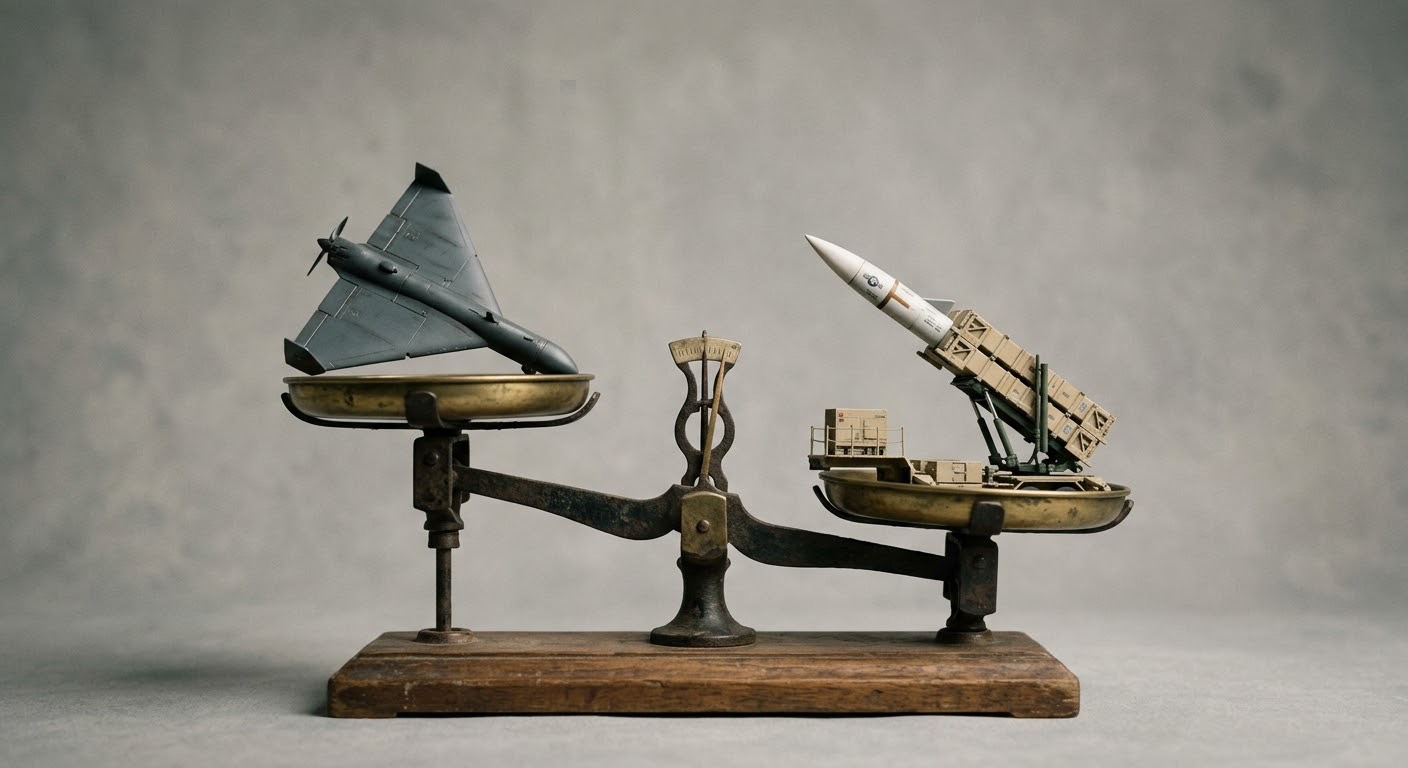
Since late 2023, Yemen's Houthis have offered another contemporary example of asymmetry: using relatively low-cost drones and anti-ship missiles, they have forced major Western naval powers to reroute merchant shipping away from the Red Sea and deploy costly shipborne air-defense systems to intercept threats that cost a fraction of what it takes to neutralize them — a cost imbalance that is the economic essence of modern asymmetric warfare.
| Conflict | Strong actor | Weak actor | Key asymmetric factor |
|---|---|---|---|
| Vietnam War | United States | Viet Cong / North Vietnam | Political attrition and strategic patience |
| Lebanon War (2006) | Israel | Hezbollah | Fortified defense and perception warfare |
| Red Sea (2023-) | Western naval coalition | Houthis | Cost per interception versus cost per attack |
| Afghanistan (2001-2021) | NATO / United States | Taliban | Regional sanctuary and time horizon |
Frequently asked questions
- How does asymmetric warfare differ from hybrid warfare?
- Asymmetric warfare describes the inequality of forces between combatants, while hybrid warfare refers to a single actor's simultaneous combination of conventional, irregular, cyber, and informational means. The two can overlap, but they are not synonyms.
- Is asymmetric warfare the same as terrorism?
- No. Terrorism is a tactic that can be used within an asymmetric strategy, but that strategy also includes conventional guerrilla warfare, sabotage, cyberattacks, or economic warfare without necessarily resorting to indiscriminate terror.
- Can a state with more resources always win an asymmetric war?
- Not necessarily. The history of Vietnam or Afghanistan shows that military superiority does not guarantee political victory if the stronger actor cannot sustain the cost and duration of the conflict better than its adversary.
Sources and references
- Andrew Mack, "Why Big Nations Lose Small Wars," World Politics, vol. 27, no. 2, 1975.
- Ivan Arreguín-Toft, How the Weak Win Wars: A Theory of Asymmetric Conflict, Cambridge University Press, 2005.
- US Department of the Army, FM 3-24 Counterinsurgency, 2006.
- David Kilcullen, The Accidental Guerrilla, Oxford University Press, 2009.
- International Institute for Strategic Studies (IISS), The Military Balance, 2006 and 2024 editions.
- Charles Esdaile, The Peninsular War: A New History, Palgrave Macmillan, 2002.
- Jacob Grønholt-Pedersen, Maersk warns of major disruption as it diverts ships away from Red Sea, Reuters, 5 January 2024: https://www.reuters.com/world/middle-east/maersk-diverts-vessels-away-red-sea-for-foreseeable-future-2024-01-05/