
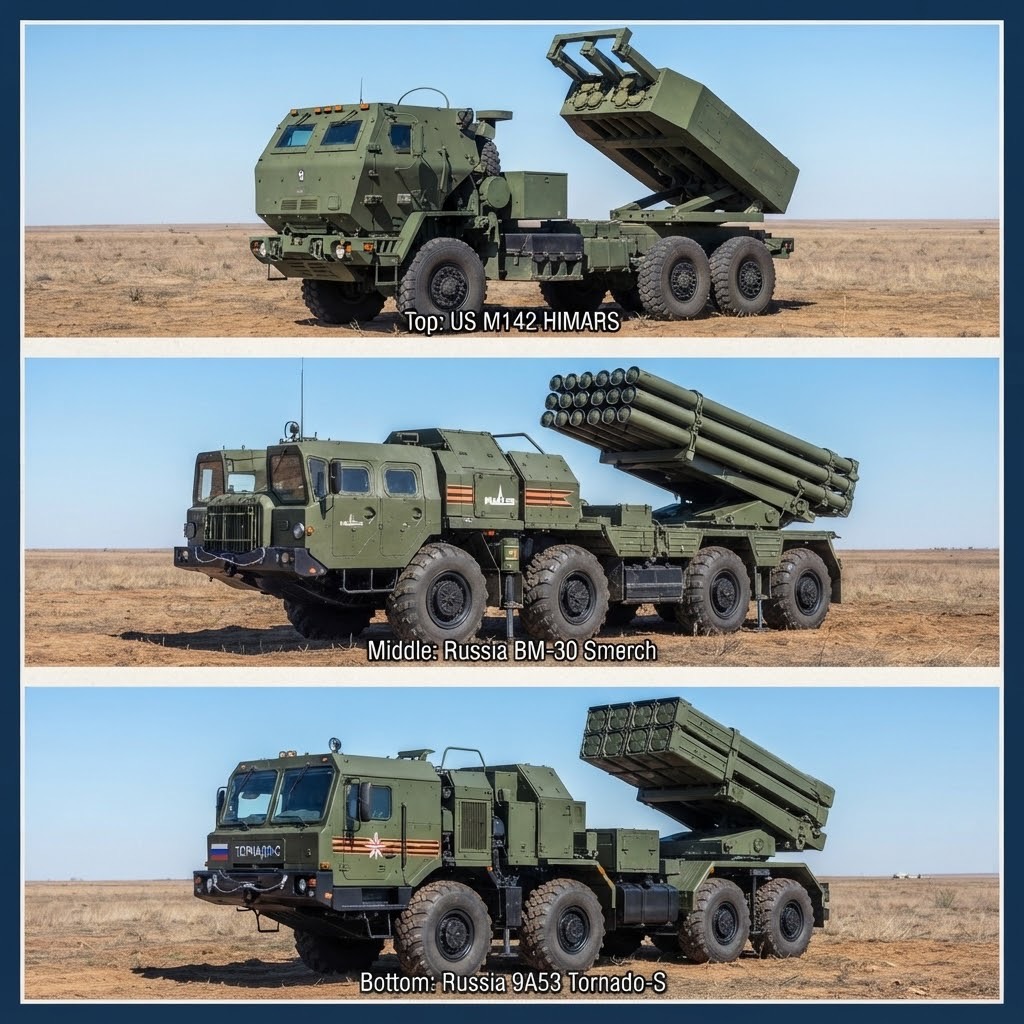
HIMARS vs Smerch and Tornado-S: Precision versus Saturation
· By Archivo Bélico editorial team · Updated
HIMARS vs Smerch and Tornado-S compared: range, accuracy, reload and doctrine of the US and Russian rocket launchers, and what the war in Ukraine has shown.
Which is better, HIMARS or Smerch? In short, they are after different things. The American HIMARS fires a handful of satellite-guided rockets that land with great accuracy; Russia's BM-30 Smerch, and its successor Tornado-S, fire salvos of twelve heavy rockets to blanket a wide area. This HIMARS vs Smerch comparison uses public data to explain why they embody two different artillery doctrines.
HIMARS vs Smerch at a glance
- HIMARS: few shots, accuracy measured in metres, fast reload and high mobility to fire and disappear.
- Smerch / Tornado-S: area saturation with 300 mm rockets; Tornado-S adds guided rockets and a longer claimed range.
Comparison table
| Feature | HIMARS (M142) | BM-30 Smerch / 9K515 Tornado-S |
|---|---|---|
| Country of origin | United States | Soviet Union / Russia |
| Rockets per load | 6 GMLRS or 1 ATACMS missile | 12 x 300 mm rockets |
| Range | About 70-80 km (GMLRS); about 300 km (ATACMS) | About 70-90 km (Smerch); up to 120 km claimed (Tornado-S) |
| Guidance | GPS and inertial on all GMLRS rockets | Mostly unguided (Smerch); guided on Tornado-S |
| Reload | Full pod in a few minutes | Crane-equipped reload vehicle, considerably slower |
| Vehicle | 6x6 wheeled truck | Heavy 8x8 truck |
Precision versus saturation
Soviet artillery was designed to strike whole areas: if you do not know exactly where the target is, you cover the entire zone. That requires a lot of rockets and huge logistics. The US doctrine of 'precision fires' does the opposite: find the target with drones, satellites or intelligence, then destroy it with one or two guided rockets. Each shot is expensive, but far fewer are needed.
Mobility and survivability
HIMARS is lighter and quicker to reload, which suits 'shoot and scoot' tactics: firing and relocating within minutes, before counter-fire arrives. Smerch delivers more firepower per salvo, but its slower reload and larger size make it more visible. In a war saturated with reconnaissance drones, the ability to move quickly has become decisive for both.
What Ukraine has shown
Ukraine received its first HIMARS in June 2022. According to analysts such as RUSI, precise strikes on Russian ammunition depots and command posts forced Russia to pull its logistics back from the front. Russia responded with dispersal, air defences and electronic warfare, which public reports say reduced the accuracy of some GPS-guided rockets. Tornado-S has been widely used on the Russian side; its real-world performance is harder to verify from independent sources.
Frequently asked questions
Frequently asked questions
- Which is better, HIMARS or Smerch?
- HIMARS is superior in accuracy, reload speed and mobility; Smerch and Tornado-S fire more rockets per salvo to cover large areas.
- What is the range of HIMARS?
- About 70-80 km with GMLRS rockets and about 300 km with the ATACMS missile, according to public data.
- What is Tornado-S?
- Russia's upgrade of the Smerch, with guided rockets and a longer claimed range, according to Russian sources.
Further reading
Sources and references
- IISS, The Military Balance 2025.
- Lockheed Martin, public material on HIMARS (M142), GMLRS and ATACMS.
- US Army, statements on HIMARS deliveries to Ukraine (2022-2023).
- Rosoboronexport and Splav/Tecmash, promotional material on the BM-30 Smerch and Tornado-S.
- RUSI, Jack Watling and Nick Reynolds, 'Meatgrinder' and other reports on the war in Ukraine (2023).
- CSIS, analysis of long-range artillery in Ukraine.