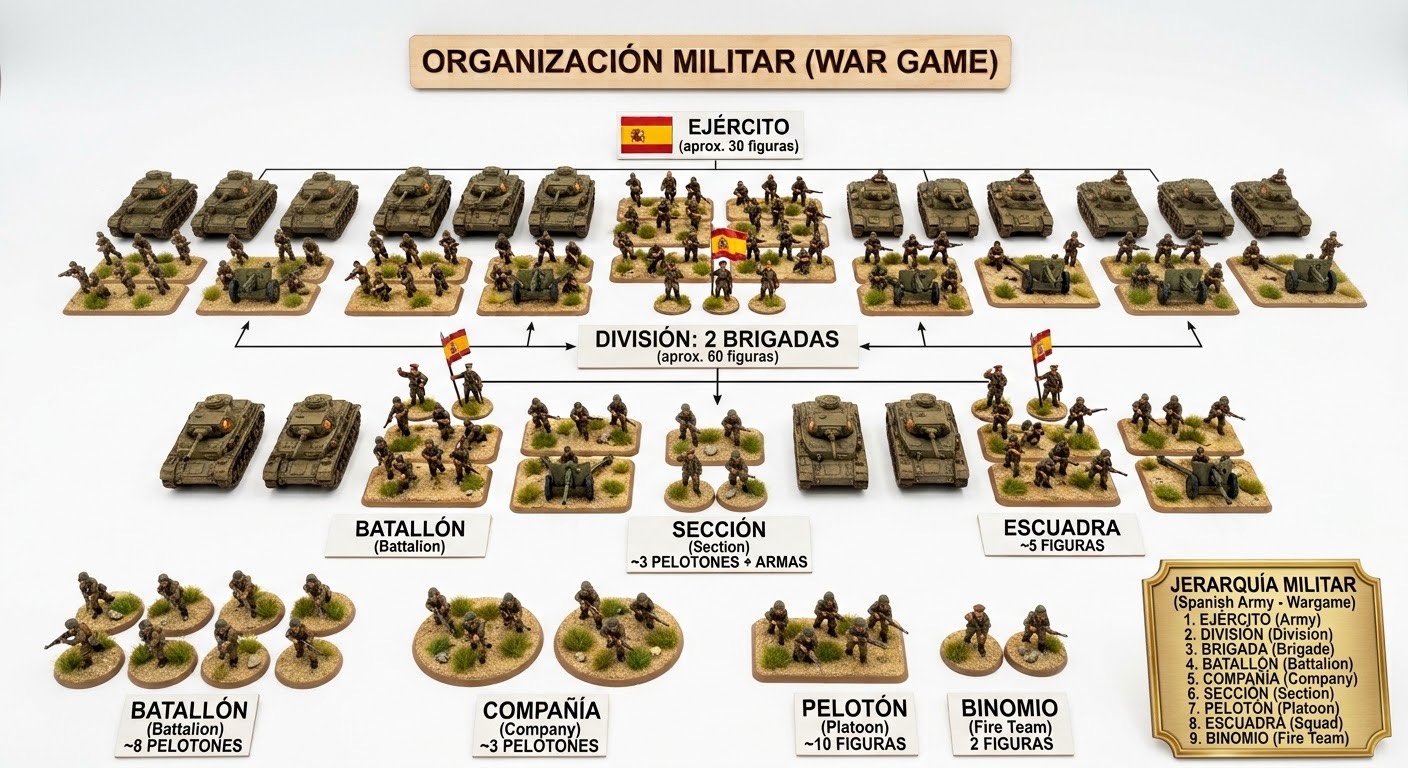
Types of Military Units: Division, Brigade, Regiment
· By Archivo Bélico editorial team
From platoon to field army: strength, command and typical role of each military echelon, plus the differences between the regimental and divisional models.
Understanding the types of military units — division, brigade, regiment and the other intermediate echelons — is key to reading any analysis of deployments, casualties or an army's combat capability with any rigor. Land forces are organized into hierarchical echelons ranging from the platoon, with a dozen or so soldiers, up to the field army, with tens of thousands, and each level has its own command, assets and characteristic tactical role.
From platoon to company: the basic tactical echelon
The platoon is the smallest unit with its own tactical identity, usually made up of 25 to 50 soldiers commanded by a lieutenant or second lieutenant, further divided into sections or squads of 8 to 12 men led by a sergeant or corporal. Several platoons form a company, with strengths ranging from 100 to 200 soldiers, normally commanded by a captain. The company is the first unit with the capacity to sustain combat somewhat more independently, though it still relies on higher echelons for fire support, logistics and command.
Battalion, regiment and brigade: the maneuver unit
The battalion groups several companies and totals between 300 and 1,000 troops depending on the army and the type of unit (infantry, armor, artillery), commanded by a lieutenant colonel. Above it sits the regiment, which in the continental tradition groups several battalions of the same arm under a colonel, while in the British model the term regiment refers more to an administrative unit steeped in historical tradition, which may not correspond to a deployed combat unit as such. The brigade, with between 3,000 and 5,000 troops commanded by a brigadier general or senior colonel, has become in recent decades the archetypal maneuver unit of modern armies, permanently combining infantry, armor, artillery, engineers and logistics under a single command, giving it more flexibility than a division for rapid-deployment operations.
Division, corps and field army
The division, with between 10,000 and 20,000 troops commanded by a major general, groups several brigades or regiments together with its own artillery, engineer, intelligence and logistics support, and has traditionally been the reference unit for planning campaigns. The corps groups several divisions (roughly 20,000 to 60,000 troops) under a lieutenant general, and already constitutes an operational rather than tactical echelon. At the top end, the field army brings together several corps and can exceed 100,000 troops under the command of a top-ranking general, coordinating operations at the theatre level.
The British regimental model versus the continental divisional model
The United Kingdom retains a regimental system with a strong historical and territorial identity, in which the regiment is chiefly the soldier's unit of belonging and tradition, while the units actually deployed in combat are typically organized as battalions folded into ad hoc brigades depending on the mission. By contrast, the continental European model, largely inherited from the Napoleonic and Prussian traditions, has for generations favored the division as the permanent combined-arms combat unit, although the trend of recent decades — including in countries such as Spain or France — has increasingly shifted toward the brigade as a flexible maneuver unit, relegating the division to a higher command role that coordinates several brigades depending on the operation.
Modern battle groups: the US BCT and the Russian BTG
The United States reorganized its Army around Brigade Combat Teams (BCTs), brigades of between 3,500 and 4,500 troops with all combined-arms assets permanently integrated, designed to deploy independently without relying on a full division. Russia, for its part, developed the Battalion Tactical Group (BTG) concept, a grouping of roughly 600-800 troops with artillery and armor support drawn from a larger brigade or division. Russia's 2022 invasion of Ukraine exposed the limits of the BTG model: by concentrating fire support while fielding relatively little organic infantry, these groupings showed problems sustaining prolonged combat and protecting their own flanks — a shortfall many defense analysts have pointed to as one of the causes of Russia's early difficulties in the conflict.
| Echelon | Approximate strength | Typical commander | Typical role |
|---|---|---|---|
| Platoon | 25-50 | Lieutenant/second lieutenant | Direct combat, basic maneuver |
| Company | 100-200 | Captain | Local tactical action |
| Battalion | 300-1,000 | Lieutenant colonel | Sustained combat unit |
| Regiment | 1,000-3,000 (variable) | Colonel | Grouping of battalions / tradition (UK) |
| Brigade | 3,000-5,000 | Brigadier general | Combined-arms maneuver unit |
| Division | 10,000-20,000 | Major general | Campaign planning |
| Corps | 20,000-60,000 | Lieutenant general | Operational level |
| Field army | +100,000 | Top-ranking general | Theatre operations |
Equivalents in the Navy and Air Force
The logic of echelons also exists in the other services, though with different names. In the Navy, the rough equivalent of a brigade or division would be a flotilla or squadron of ships under an admiral, while the basic combat unit is the ship itself and its crew. In the air force, the basic echelon is the squadron (roughly equivalent to a battalion), grouped into wings or air groups (equivalent to brigades), in turn integrated into larger air commands that play a role similar to that of a corps.
- Platoon and section: the echelon in direct contact with the enemy.
- Company and battalion: the first units able to sustain combat on their own.
- Brigade: the reference combined-arms maneuver unit in today's armies.
- Division and corps: operational-planning echelons.
- BCT and BTG: modern adaptations of the brigade concept for agile deployment.
Frequently asked questions
- What is the difference between a brigade and a division?
- The brigade is a smaller maneuver unit (3,000-5,000 troops) with all combined-arms assets permanently integrated, while the division (10,000-20,000 troops) groups several brigades or regiments and adds a further layer of command and support to plan larger campaigns.
- Why doesn't the British regiment correspond to the continental regiment?
- In the British model, the regiment is mainly a unit of tradition and historical identity, while the forces actually deployed are organized as battalions folded into brigades; in the continental model, the regiment does group battalions as a deployable combat unit.
- What problem did the Russian BTG model show in Ukraine?
- The Battalion Tactical Group concentrated fire support but had relatively little organic infantry, which made it hard to sustain prolonged combat and protect its flanks — a factor many analyses point to as one of the causes of Russia's early difficulties in the 2022 invasion.
- Do these echelons have equivalents in the Navy and Air Force?
- Yes, though under different names: in the Navy, squadrons or flotillas of ships play a role similar to brigades or divisions, and in the air force, squadrons, wings and air commands mirror an equivalent echelon structure to battalion, brigade and corps.