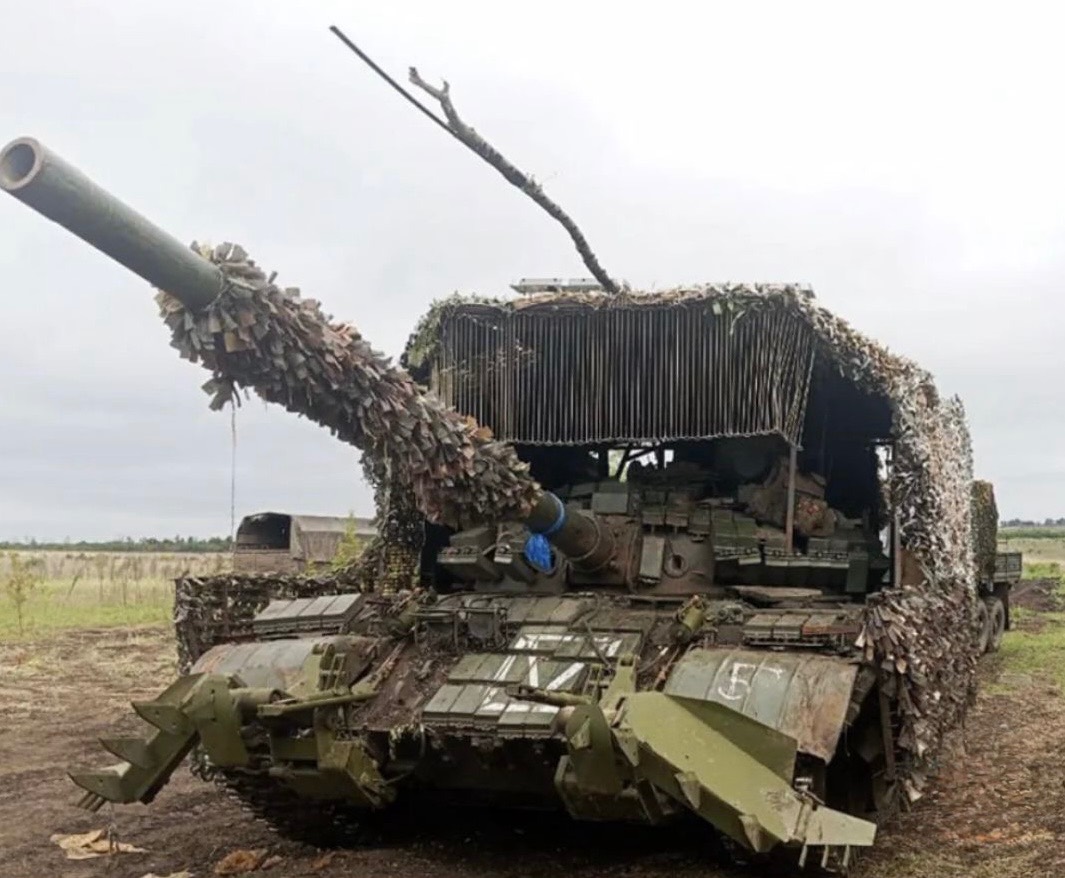
Anti-Drone Nets on Tanks: Cope Cages Explained
· By Archivo Bélico editorial team
Why anti-drone cages and nets appeared on tanks in Ukraine, how they evolved from improvisation to industrial design, and how effective they really are.
Anti-drone cages and nets mounted on tanks and armored vehicles have become one of the most recognizable images of the war in Ukraine. They began as improvised structures of welded bars and wire mesh — what the English-language press dubbed "cope cages," with clear irony — and have ended up incorporated into protection kits from industrial manufacturers and into several armies' own modernization programs.
Why they emerged
Cages appeared on Russian vehicles even before the 2022 invasion, initially conceived against top-attack munitions. With the massive spread of shaped-charge FPV drones from 2023 onward, both sides began covering roofs and turrets, and then the sides and rear of their vehicles. The reason is simple: a tank's top armor is far thinner than its frontal armor, and a cheap drone can choose exactly where to strike.
From improvisation to workshop and factory
The earliest versions were the work of crews and field workshops: bars, chicken wire, wire mesh, hanging chains. Then came brigade-workshop designs, lighter and hinged so as not to block hatches or turret rotation. Finally, manufacturers in several countries have developed commercial cage and net kits, and Western armies have begun incorporating anti-drone protection into their specifications.
How they are supposed to work
The principle is the same as the old World War II skirts and anti-bazooka screens: interpose a structure at some distance from the armor so the munition detonates early or is deflected, degrading the shaped-charge jet. Against drones, the goal is also to physically snag the device or make it lose its angle of impact. In practice, flexible nets have proven useful for tangling propellers, and rigid cages for detonating the charge at a distance from the hull.
| Type | Origin | Advantages | Drawbacks |
|---|---|---|---|
| Improvised cage | Crew or field workshop | Fast and cheap | Heavy, hampers visibility and hatches |
| Flexible net | Brigade workshop | Light, tangles propellers | Degrades with use and weather |
| Industrial kit | Defense manufacturers | Integrated, tested design | Cost and supply lead times |
| Full-envelope armor ("turtle") | Russian improvisation | Near-total coverage | Greatly reduces vision and mobility |
How effective are they really
The honest answer is that there is no rigorous public data to quantify it. Analyses by RUSI and other think tanks agree in describing them as a partial measure: they reduce the probability of destruction or catastrophic damage in some attacks, but do not protect against hits on exposed areas, against multiple consecutive drones, or against more powerful munitions. They add weight, worsen crew visibility, complicate maintenance and can hinder the use of hatches and turret weapons.
Extreme examples, such as the fully enclosed Russian vehicles the press nicknamed "turtle tanks," illustrate the trade-off: apparent protection is gained while situational awareness and mobility are lost, two factors that also save lives. Most analysts present cages as one element within a layered system — electronic warfare, short-range air defense, dispersion, camouflage and active protection — not as a solution in themselves.
- They do not replace electronic warfare or short-range air defense.
- Their effectiveness depends on the type of drone and the payload it carries.
- They add weight, reduce visibility and complicate maintenance.
- Their morale value for the crew is frequently noted by the combatants themselves.
Frequently asked questions
- What is a cope cage?
- A structure of welded bars and mesh over an armored vehicle's turret or roof, meant to detonate or deflect top-attack munitions and drones before they reach the armor.
- Do anti-drone nets work?
- They reduce risk in some attacks, mainly by tangling propellers or detonating the charge away from the hull, but no public data exists to quantify their effectiveness, and they do not protect against every case.
- Why isn't the whole vehicle covered?
- Because so-called turtle armor severely penalizes visibility, ventilation and mobility, factors that also determine the crew's chances of survival.
Sources and references
- RUSI, publications on tactical adaptation and armor protection in Ukraine
- IISS, Military Balance Blog: analysis on improvised anti-drone protection
- Forbes, documented coverage on cope cages and improvised armor in Ukraine
- CSIS, analysis on FPV drones and countermeasures
- Steven J. Zaloga, Armored Champion: The Top Tanks of World War II, Stackpole Books, 2015 (for the anti-bazooka screen precedent).