Combat Engineers and Sappers: What They Do
· By Archivo Bélico editorial team
What sappers and combat engineers are: breaching, mine-laying and clearance, bridging, fortification and demolitions, from ancient sieges to modern war.
Sappers — today more commonly called combat engineers — are the units tasked with shaping the terrain so that friendly forces can move and the enemy cannot. Their work rarely features in epic battle narratives, but it conditions almost everything else: without a bridge laid in time, without a breach cleared through a minefield, without a fortified position, the maneuver of infantry and armor simply does not happen.
Western doctrine sums up their mission in three broad functions: mobility (enabling friendly advance), counter-mobility (slowing the enemy's) and survivability (protecting the force through fieldworks). Many armies add a fourth: general engineering support — roads, camps, water supply or infrastructure repair.
From sapping to combat engineering
The word comes from "sap," the tool and technique of digging used in siege warfare to approach a wall under cover from defensive fire. Working "by sap" meant digging zigzag trenches toward the besieged stronghold and, when the moment came, mining it: digging a gallery under the wall to bring it down. The military engineer of the Ancien Régime was, above all, a specialist in fortification and siegecraft, a discipline that reached its most influential form in Europe with Sébastien Le Prestre de Vauban, in the service of Louis XIV.
The industrialization of war broadened the trade. In the First World War, engineers built and maintained the labyrinth of trenches, dugouts and wire on the Western Front, and returned to large-scale underground mining. In the Second, the emphasis shifted to mobility: laying bridges, clearing beach obstacles and cutting lanes through minefields so mechanized columns would not stall.
What a combat engineer does today
Mobility: opening the way
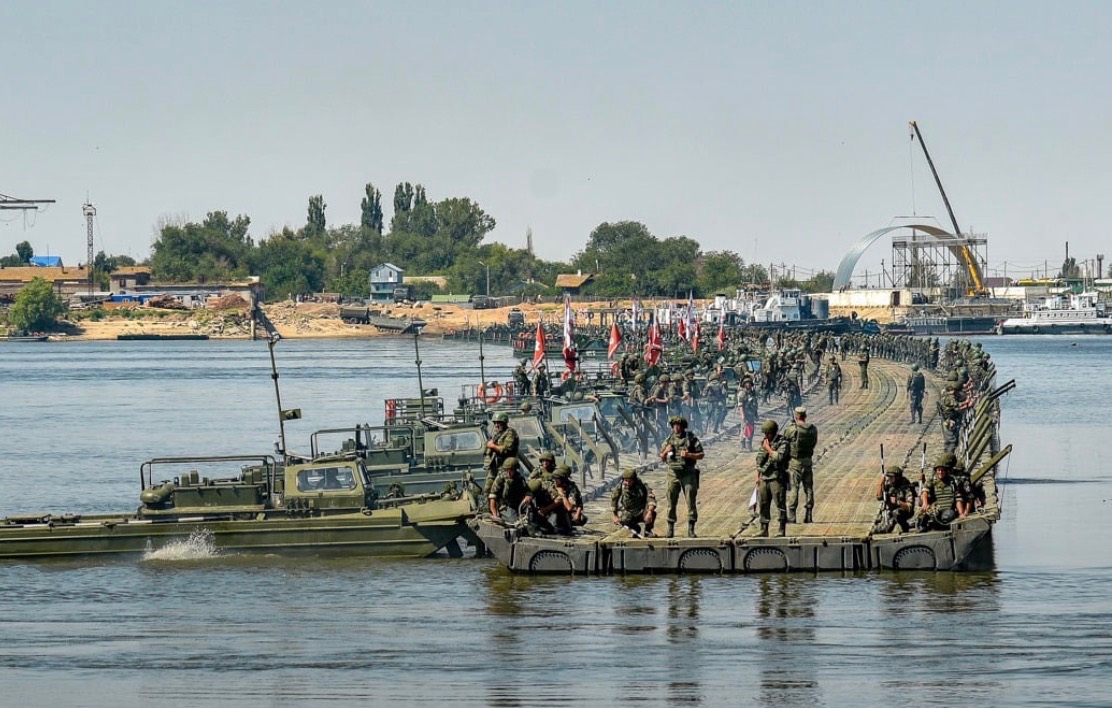
Breaching is the most dangerous and characteristic task. It means creating and marking a safe corridor through an obstacle — minefield, anti-tank ditch, wire — under enemy fire. It combines mechanical means (plows and rollers mounted on tanks), explosives (line charges fired across the field to detonate mines by sympathetic explosion) and manual reconnaissance work. Crossing rivers is the other major mission: assault bridges launched from a tank chassis, floating bridges made of modular sections, and rafts for fording points.
Counter-mobility: closing the way
The reverse operation involves channelling the adversary to where it suits you: defensive mine-laying, blowing bridges and road junctions, ditches and anti-tank obstacles, controlled flooding. The goal is usually not to stop an advance outright but to slow it and force it into predictable chokepoints, where artillery and anti-tank weapons are waiting.
Survivability: fortifying
Digging remains one of the cheapest ways to survive. Engineers prepare dug-in positions for personnel and vehicles, shelters, protected command posts and protective works using earth, concrete or filled containers. The war in Ukraine has brought large-scale field fortification back to the fore: continuous trench lines, concrete obstacles and minefields stretching for dozens of kilometres.
Mine clearance and explosive disposal
Opening a breach in combat is one thing; clearing land to return it to the population is quite another. Humanitarian demining is slow, methodical and governed by international standards demanding a very high degree of verified clearance. According to the Landmine and Cluster Munition Monitor, the vast majority of casualties recorded each year from mines and explosive remnants of war are civilians, and a very large share are children. Ukraine, since Russia's full-scale invasion in 2022, is one of the most extensively contaminated countries in the world, with clearance tasks estimated to take decades.
In parallel, explosive ordnance disposal (EOD) units deal with unexploded bombs, abandoned munitions and improvised devices. In Iraq and Afghanistan, the spread of IEDs made this one of the most in-demand and highest-risk specialties among deployed forces.
How they are organized
In most armies, two layers coexist. The first is combat engineer units embedded in maneuver brigades: they accompany infantry and armor, with protected vehicles and breaching teams. The second is higher-level engineering units, with heavy machinery, greater bridging capacity and construction missions. In Spain, the Army's Engineer Corps groups both sappers and signals specialties historically linked to it; in the United Kingdom and the United States, the Royal Engineers and the US Army Corps of Engineers combine military tasks with public-works ones.
| Function | Typical task | Intended effect |
|---|---|---|
| Mobility | Minefield breach, assault bridge | Keep friendly maneuver from stalling |
| Counter-mobility | Mine-laying, blowing bridges, obstacles | Channel and delay the adversary |
| Survivability | Dug-in positions, shelters, protection | Reduce casualties and materiel losses |
| General support | Roads, water, camps, repairs | Sustain the force over time |
Why they remain decisive
The war in Ukraine has offered a highly visible reminder. River crossings have been extremely costly operations whenever the adversary could observe and hit them with artillery and drones, and mechanized offensives have repeatedly stalled against dense minebelts combined with obstacles and indirect fire. Analysts at the Royal United Services Institute have noted that mine density and the difficulty of breaching under constant observation have been central factors in the slow pace of offensive operations. Where materiel superiority once sufficed, today the engineering problem must also be solved.
Frequently asked questions
- Are sappers and combat engineers the same thing?
- In practice, yes: "sapper" is the traditional term and "combat engineer" the more common one in current doctrine. Both describe the soldier specialized in mobility, counter-mobility, fortification and demolitions.
- What is their most dangerous mission?
- Breaching minefields under enemy fire, because it forces them to work slowly, at a predictable point and in full view of the adversary.
- Do military engineers do humanitarian demining?
- They can take part, but it is a different task: humanitarian demining seeks verified, complete clearance of the land under international standards, not simply opening a safe path for one operation.
- What's the difference between mining and fortifying?
- Mining is counter-mobility: it aims to slow or divert the enemy. Fortifying is survivability: it aims to protect friendly forces. They are often combined within the same defensive position.