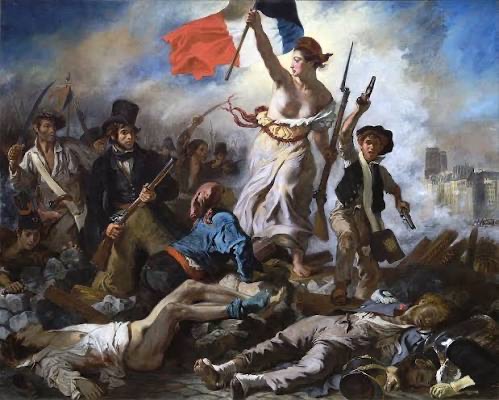
The Levée en Masse and the Shift to Total War in 1793
· By Archivo Bélico editorial team
The levée en masse and the shift to total war: how revolutionary France mobilized an entire nation and changed the nature of warfare forever.
The levée en masse and the shift to total war mark one of the deepest ruptures in modern military history: the moment war ceased to be the exclusive business of professional armies and monarchs and became the enterprise of entire nations. The French decree of 23 August 1793, which in theory mobilized the whole population of the Republic for combat, production, or logistical support, closed the era of the Ancien Régime's limited wars and opened the door to the kind of conflict Clausewitz would later theorize under the concept of "absolute war."
The cabinet wars of the Ancien Régime
Through the 17th and 18th centuries, European war was largely "cabinet war": waged by monarchs and their ministers through professional armies that were costly to maintain and relatively small, made up of enlisted soldiers, mercenaries, and volunteers often recruited from society's most marginal groups. Armies such as Prussia's under Frederick II or France's under Louis XV numbered between 100,000 and 200,000 men — enormous for the time, but limited compared to their kingdoms' real demographic potential.
This restraint had both practical and political roots: arming the general population was risky for monarchies wary of internal uprisings, and the goal of war was usually limited to negotiable territorial or dynastic gains, not the enemy's destruction. Historians such as Hans Delbrück described this logic as a "strategy of attrition" (Ermattungsstrategie), as opposed to the later "strategy of annihilation." Battles, though bloody — Malplaquet in 1709 left more than 20,000 casualties — reflected cabinet calculations rather than a society's total mobilization.
The August 1793 decree and the nation in arms
Revolutionary France, threatened simultaneously by the coalition of European powers and by civil war in the Vendée, broke that model. On 23 August 1793, the National Convention passed, on a proposal by Lazare Carnot and Bertrand Barère, the levée en masse decree, proclaiming that "until the enemies have been driven from the territory of the Republic, all Frenchmen are in permanent requisition for the armies' service."
What the decree set out
- Unmarried young men and childless widowers, aged 18 to 25, would march to the front.
- Married men would forge weapons and transport supplies.
- Women would make tents and uniforms and serve in hospitals.
- Children would turn old linen into lint for bandages.
- The elderly would be brought to public squares to "rouse the courage of the fighters" and preach hatred of kings.
The effect was immediate: the French army, which numbered around 645,000 enlisted men in 1793 (though its effective operational strength was smaller), mobilized on paper close to 1.5 million people between 1793 and 1794, an unprecedented figure in modern Europe. This allowed the Republic to sustain simultaneous war on several fronts — the Low Countries, the Rhineland, the Pyrenees, Italy — and to crush the internal uprising in the Vendée.
From revolutionary levy to the Napoleonic wars
Napoleon Bonaparte inherited and refined this model with the regular conscription system established by the 1798 Jourdan Law, which replaced emergency mobilization with a systematic annual draft by age cohort. This allowed the Grande Armée to grow beyond 600,000 men during the 1812 Russian campaign, a figure no Ancien Régime army could have imagined. Napoleonic warfare also generalized its impact on civilians: mass requisitions of food and horses, prolonged occupations, the Continental Blockade that disrupted entire economies, and campaigns such as the one in Spain (1808-1814), where the guerrilla resistance directly drew the civilian population into armed struggle, with episodes such as the sieges of Zaragoza.
| Aspect | Ancien Régime (18th c.) | Revolutionary/Napoleonic France |
|---|---|---|
| Recruitment | Volunteers, mercenaries, replacements | General levy and annual conscription |
| Typical army size | 100,000-200,000 men | 300,000-600,000+ men (Grande Armée, 1812) |
| War aim | Limited territorial/dynastic gains | Total defeat of the enemy, regime change |
| Role of civilians | Marginal, removed from direct war effort | Mobilized in production, support, and sometimes combat |
| Financing | Taxes and limited royal credit | Requisitions, war economy, plunder of occupied territories |
Clausewitz and the theory of absolute war
Carl von Clausewitz, a witness to the Napoleonic wars as a Prussian officer, set out in his posthumous work On War (1832) the distinction between real war, limited by political and logistical friction, and "absolute war," a theoretical concept of unlimited violence that war tends toward when both sides are pushed to mobilize all their resources. Clausewitz saw in the levée en masse and the Napoleonic campaigns the historical proof that when a state's politics equate its survival with total military victory, war tends to break free of the traditional limits of 18th-century cabinet warfare.
War is thus an act of force to compel our enemy to do our will... carried to its logical extreme, it recognizes no limit but the exhaustion of each side's strength.
Carl von Clausewitz, On War, 1832
This idea laid the conceptual groundwork for what the 20th century would call outright "total war," a category applied retrospectively to conflicts such as the First and Second World Wars, in which entire economies, industries, and civilian populations were absorbed into the war effort. The 1793 levée en masse is, in that sense, the first great documented historical precedent of total national mobilization, and its legacy can be traced directly to modern conscription and the notion of the "nation in arms" that defined the 19th and 20th centuries.
Frequently asked questions
- What exactly is the levée en masse?
- It is the decree passed by the French National Convention on 23 August 1793 that placed the entire population, according to age and sex, at the service of the war effort, from combat to the production of weapons and supplies.
- How does it differ from later Napoleonic conscription?
- The levée en masse was an emergency, exceptional mobilization in response to the 1793 invasion, while the 1798 Jourdan Law established a regular, annual conscription system by age cohort that sustained the Napoleonic armies.
- Why is it linked to Clausewitz and absolute war?
- Clausewitz lived through the Napoleonic wars and used their logic of total mobilization as the basis for theorizing "absolute war," a conceptual extreme that war tends toward when the entirety of a nation's resources is committed.
- Did total war really begin in 1793?
- The term "total war" was coined in the 20th century, but most historians place in the levée en masse and the Napoleonic wars the first clear precedent of mass national mobilization that anticipates that logic.
Sources and references
- Carl von Clausewitz, On War, 1832 (ed. La Esfera de los Libros, 2005).
- Hans Delbrück, History of the Art of War, University of Nebraska Press, 1990 (orig. ed. 1900-1920).
- David A. Bell, The First Total War: Napoleon's Europe and the Birth of Warfare as We Know It, Houghton Mifflin, 2007.
- Geoffrey Best, War and Society in Revolutionary Europe, 1770-1870, Fontana Press, 1982.
- Jean-Paul Bertaud, La Révolution armée: les soldats-citoyens et la Révolution française, Robert Laffont, 1979.
- Convention Nationale, "Décret de la levée en masse," 23 August 1793, Archives Nationales de France.
- Charles Esdaile, Napoleon's Wars: An International History, 1803-1815, Penguin, 2007.