
Psychological Warfare at the Front: Stuka Sirens, Bombardment and Fear
· By Archivo Bélico editorial team · Updated
How sound, bombardment, and displays of firepower were used as weapons of terror on the battlefield: the documented truth about the Ju 87 Stuka's Jericho-Trompete sirens, moral shock under fire, and other historical examples, myths debunked.
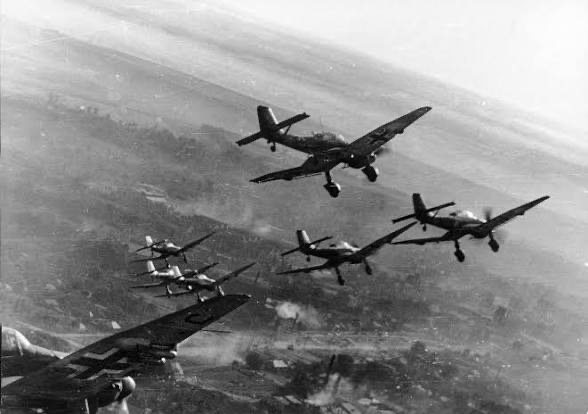
Beyond doctrine and staff-level planning, psychological warfare is also fought on the battlefield itself: sound, bombardment, and the staging of firepower function as weapons of terror aimed at morale, not just at the enemy's body. This article reviews, with special attention to separating documented fact from legend, the most cited case in this category: the sirens of the German Junkers Ju 87 'Stuka' dive bomber.
The Stuka's Jericho-Trompete sirens: what the sources say
The Junkers Ju 87, nicknamed 'Stuka' (from Sturzkampfflugzeug, 'dive bomber'), was fitted in its B variant with so-called 'Jericho-Trompete' (Jericho trumpets): propeller-driven sirens roughly 0.7 meters in diameter, mounted on the wing's leading edge or on the fixed landing-gear fairing [2](https://aviation.stackexchange.com/questions/9525/why-did-the-ju-87-stuka-have-a-siren).
Their function was purely psychological: technical analysis confirms the sirens provided no ballistic or targeting advantage whatsoever, and in fact hurt aircraft performance by adding aerodynamic drag that cut speed by roughly 20-25 km/h (10-20 mph) [2](https://aviation.stackexchange.com/questions/9525/why-did-the-ju-87-stuka-have-a-siren).
The exact origin of the idea remains subject to some historical uncertainty: it is unclear whether it came from Adolf Hitler himself or from flying ace and Luftwaffe research-and-development chief Ernst Udet, a major driving force behind the dive-bombing program [3](https://www.warhistoryonline.com/instant-articles/trumpets-jericho-luftwaffe.html).
The documented effect on morale
The siren's sound, combined with the Stuka's near-vertical dive (roughly 80 degrees) and bombing precision, produced a well-documented terror effect among infantry troops and civilians, particularly during the Polish campaign (1939), the campaign in France and the Low Countries (1940), and the Battle of Britain [4](https://historynet.com/german-stuka/).
An additional hypothesis, noted in specialized sources, holds that the sonic panic was also meant to destabilize horse-drawn transport units, still predominant in several armies — Polish, French, and Soviet — at the start of the war, while the more motorized British and American forces were, in theory, less vulnerable to that particular effect [2](https://aviation.stackexchange.com/questions/9525/why-did-the-ju-87-stuka-have-a-siren).
Why they were removed: debunking the myth of permanent effectiveness
Contrary to the popular image of an unbeatable terror weapon throughout the war, technical sources agree that the sirens were removed from most operational aircraft once enemy troops grew accustomed to the sound and it stopped producing the initial panic, since the aerodynamic cost — lost speed and maneuverability — no longer offset the diminishing psychological payoff [2](https://aviation.stackexchange.com/questions/9525/why-did-the-ju-87-stuka-have-a-siren).
As a partial substitute, the Luftwaffe fitted whistles to the tail fins of some bombs, reproducing a similar descending sound without penalizing the carrier aircraft's aerodynamics [2](https://aviation.stackexchange.com/questions/9525/why-did-the-ju-87-stuka-have-a-siren).
Another common myth is worth correcting: the Stuka ceased to be a viable platform in skies contested by modern fighters as early as summer 1940, when the Royal Air Force shot down nearly sixty of them during the Battle of Britain — showing that its vulnerability to interception, not merely the loss of sonic surprise, limited its use in theaters with enemy air superiority [4](https://historynet.com/german-stuka/).
A postwar legacy: the CIA's 'Jericho Horn' project
More than a decade after the war ended, the US Central Intelligence Agency launched, in 1958, a project internally known as the 'Screamer Project' to develop an aircraft-mountable siren for psychological warfare, explicitly inspired by the Stuka's device [5](https://www.twz.com/32966/cia-tracked-down-a-nazi-scoured-museums-to-build-an-aircraft-siren-to-scare-the-hell-out-of-people).
Declassified documents available through the CIA's records search tool (CREST) show the Agency went as far as tracking down the original designer of the German device and consulting American museums for technical information about the Stuka before building its own prototypes, intended to work with a P-51 Mustang fighter at speeds of 280-300 mph and low altitude [5](https://www.twz.com/32966/cia-tracked-down-a-nazi-scoured-museums-to-build-an-aircraft-siren-to-scare-the-hell-out-of-people).
The specific reason the device was requested remains partly classified, though records indicate the requirement was tied to a high-priority project of the Agency's Far East Division [5](https://www.twz.com/32966/cia-tracked-down-a-nazi-scoured-museums-to-build-an-aircraft-siren-to-scare-the-hell-out-of-people).
Bombardment and artillery as weapons of fear: beyond the Stuka
Sound was not the only vector of terror at the front. Sustained exposure to bombardment or artillery fire was itself shown, as early as the First World War, to have devastating and long-lasting psychological effects, clinically documented under the label 'shell shock.'
Historians of British military medicine recorded hundreds of cases of soldiers losing speech, hearing, or motor control after intense bombardment, with no apparent physical injury — a phenomenon that forced, for the first time on a large scale, a rethinking of the relationship between exposure to massed fire and psychological collapse in combat [6](https://encyclopedia.1914-1918-online.net/pdf/1914-1918-Online-war_psychiatry_and_shell_shock-2019-12-11-V2.0.pdf).
Historiography on British morale in the First World War situates shell shock within a broader crisis of combatant identity and emotional endurance in the face of an artillery-and-trench war of unprecedented destructive scale [7](https://encyclopedia.1914-1918-online.net/article/subjectivity-and-emotions-great-britain-and-ireland/).
Audible propaganda at the front: loudspeakers and combat broadcasting
Another documented channel of sonic psychological warfare, distinct from aviation sirens, was the use of frontline loudspeakers and broadcasts aimed directly at enemy lines. In the Korean War, the US 1st Radio Broadcasting & Leaflet Group integrated loudspeaker units alongside broadcasting and leaflet drops as part of a strategic and tactical psychological warfare campaign [8](https://arsof-history.org/articles/v7n1_proper_ganders_page_1.html).
Separating fact from myth: summary
- True: the Stuka's Jericho-Trompete were mechanical propeller-driven sirens with no ballistic function, confirmed by multiple technical and historical sources [2](https://aviation.stackexchange.com/questions/9525/why-did-the-ju-87-stuka-have-a-siren).
- True: they cost the aircraft speed and were removed once they stopped surprising the enemy, partly replaced by whistling bombs [2](https://aviation.stackexchange.com/questions/9525/why-did-the-ju-87-stuka-have-a-siren).
- True: the CIA replicated the concept in a postwar project documented in declassified files [5](https://www.twz.com/32966/cia-tracked-down-a-nazi-scoured-museums-to-build-an-aircraft-siren-to-scare-the-hell-out-of-people).
- Myth to avoid: that the Stuka was an invincible weapon throughout the war thanks to sonic terror; in reality, its vulnerability to modern fighters relegated it to theaters without enemy air superiority from 1940 onward [4](https://historynet.com/german-stuka/).
- Myth to avoid: that the origin of the idea is confirmed beyond doubt; sources attribute it to both Hitler and Udet, without a definitive documentary consensus [3](https://www.warhistoryonline.com/instant-articles/trumpets-jericho-luftwaffe.html).
Editorial note
This article is intended for historical and educational purposes. It describes documented past phenomena of psychological warfare, without providing technical or operational instructions, and draws on specialized journalism, declassified archives, and academic literature on war psychiatry.
Frequently asked questions
- Did the Stuka's sirens serve any purpose beyond scaring people?
- No. Technical sources agree their only function was psychological; they did not improve aim or provide any combat advantage, and in fact reduced the aircraft's speed due to the drag they created [1](https://aviation.stackexchange.com/questions/9525/why-did-the-ju-87-stuka-have-a-siren).
- Why did the Luftwaffe stop using them?
- Because their surprise effect wore off as enemy troops grew accustomed to the sound, at which point the aerodynamic cost no longer offset the diminishing psychological benefit; they were partly replaced by tail-mounted whistling bombs [1](https://aviation.stackexchange.com/questions/9525/why-did-the-ju-87-stuka-have-a-siren).
- Is it true the CIA copied the Stuka's idea?
- Yes, this is documented in declassified files: in 1958 the CIA launched a project to build an aircraft siren explicitly inspired by the German device, even tracking down its original designer [2](https://www.twz.com/32966/cia-tracked-down-a-nazi-scoured-museums-to-build-an-aircraft-siren-to-scare-the-hell-out-of-people).
Sources and references
- War History Online, 'Junkers Ju 87Bs Utilized Psychological Warfare Against Allied Ground Troops' (2022) — https://www.warhistoryonline.com/aircraft/junkers-ju-87b-psychological-warfare.html
- War History Online, 'The Trumpets of Jericho — How the Luftwaffe Used Sirens Attached To Stuka Dive Bombers' (2017) — https://www.warhistoryonline.com/instant-articles/trumpets-jericho-luftwaffe.html
- HistoryNet, 'This German Dive-Bomber Terrified the Brits in 1940. What Made the Jericho Trumpet So Frightening?' (2023) — https://historynet.com/german-stuka/
- Aviation Stack Exchange, 'Why did the Ju-87 Stuka have a siren?' — https://aviation.stackexchange.com/questions/9525/why-did-the-ju-87-stuka-have-a-siren
- The War Zone (TWZ), 'CIA Tracked Down A Nazi, Scoured Museums To Build An Aircraft Siren To Scare The Hell Out Of People' (2020) — https://www.twz.com/32966/cia-tracked-down-a-nazi-scoured-museums-to-build-an-aircraft-siren-to-scare-the-hell-out-of-people
- Fiona Reid, 'War Psychiatry and Shell Shock', International Encyclopedia of the First World War (2019) — https://encyclopedia.1914-1918-online.net/pdf/1914-1918-Online-war_psychiatry_and_shell_shock-2019-12-11-V2.0.pdf
- Jessica Meyer, 'Subjectivity and Emotions (Great Britain and Ireland)', 1914-1918-online — https://encyclopedia.1914-1918-online.net/article/subjectivity-and-emotions-great-britain-and-ireland/
- Briscoe & Jones, 'The Proper Ganders: 1st Radio Broadcasting & Leaflet Group, Strategic Psywar in Korea, 1951-1954', ARSOF History — https://arsof-history.org/articles/v7n1_proper_ganders_page_1.html