China's Maritime Militia: Fishing Boats, Coast Guard, Gray Zone
· By Archivo Bélico editorial team
How China integrates its civilian fleet and coast guard into naval strategy: maritime militia, the 2021 law, mobilizable national defense, and the South China Sea.
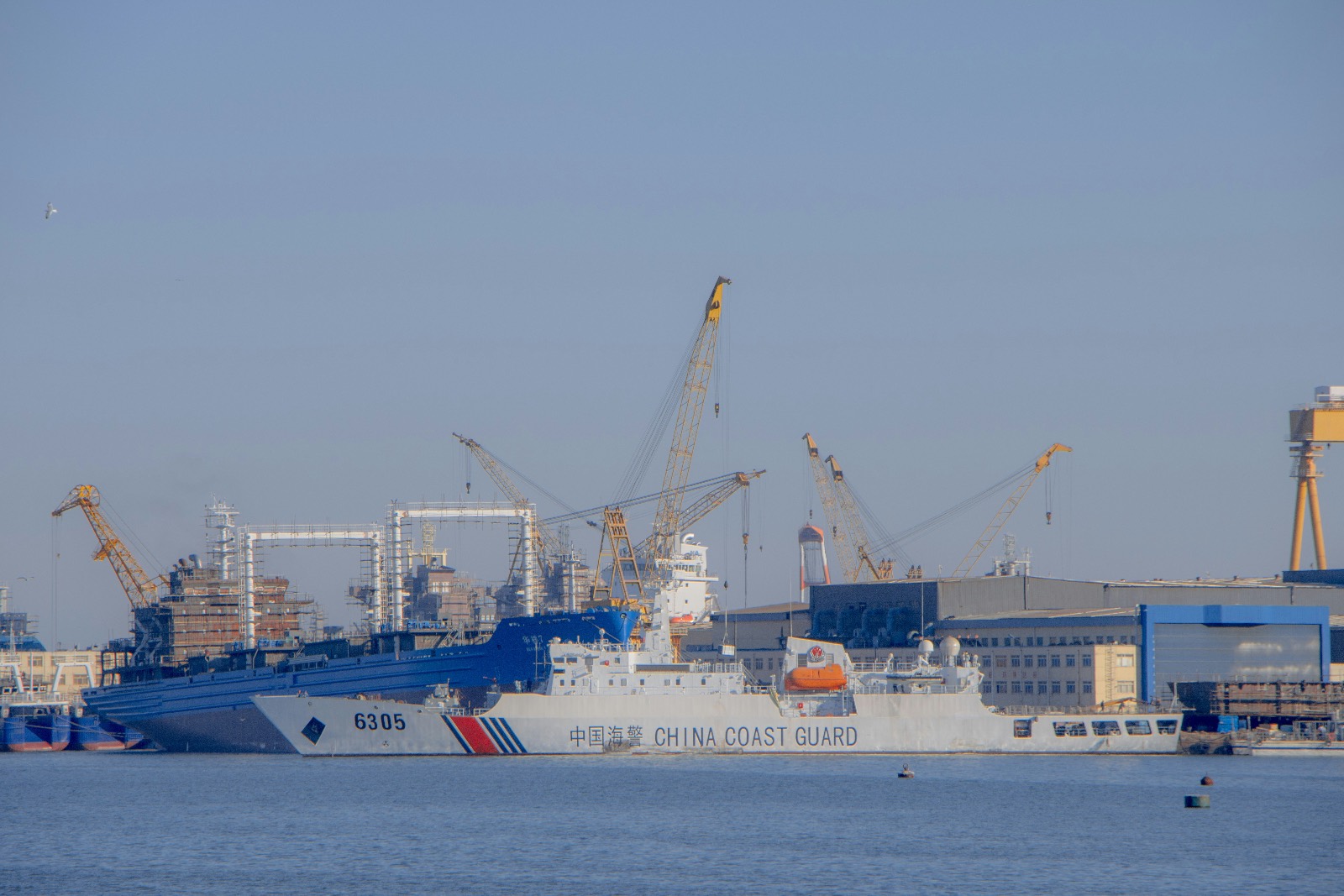
China is the only major power that openly and formally organizes a third naval force alongside its navy: the Maritime Militia of the People's Armed Forces, made up of civilian vessels — mostly fishing boats — with trained, organized crews that can be mobilized for state tasks. Together with a coast guard that has become the largest in the world, this structure allows China to apply continuous pressure in disputed waters without deploying warships, in other words, operating below the threshold of armed conflict. It is the most closely studied example of gray-zone naval operations.
The legal framework: mobilizing civilian assets
The idea that civilian assets are a defense resource is written into Chinese law. The National Defense Law (1997, revised in 2020) and the National Defense Transportation Law, in force since January 2017, establish obligations for companies and owners of means of transport, including merchant ships. In 2015, the Ministry of Transport published technical standards requiring certain newly built civilian vessels — container ships, ro-ro ferries, bulk carriers, tankers, and ferries — to incorporate reinforcements from the design stage that would facilitate military use in the event of mobilization. The underlying principle, "military-civil fusion" (junmin ronghe), was elevated to national strategy in 2015.
What it means and what it doesn't
It's worth clarifying the scope: this does not mean that every Chinese fishing boat is a covert warship, nor that the entire merchant fleet is militarized. It means there is a legal and technical framework allowing civilian tonnage to be requisitioned and adapted, and that an identified segment of the fishing fleet — concentrated in ports such as Tanmen, in Hainan — receives subsidies, training, and communications equipment for state-presence tasks. Studies by the US Naval War College (Andrew Erickson and Conor Kennedy) document these programs using official Chinese sources and local press.
The coast guard: the front-line force
The China Coast Guard (CCG) was created in 2013 by merging several maritime agencies and, since July 2018, has answered to the Central Military Commission through the People's Armed Police. It is the largest coast guard in the world by tonnage: it operates dozens of large-displacement cutters, including the Zhaotou-class vessels, of roughly 10,000 tons — bigger than many destroyers. The Coast Guard Law passed in January 2021 explicitly authorizes the use of weapons against foreign vessels in waters China considers under its jurisdiction and allows ordering the demolition of other countries' structures in those areas — a text that Japan, the Philippines, Vietnam, and the United States criticized for its ambiguity.
Documented episodes in the South China Sea
- Scarborough Shoal (2012): a standoff between a Philippine Navy ship and Chinese fishing boats, with Chinese maritime surveillance vessels interposing, ended with de facto Chinese control of the reef.
- Whitsun Reef (March 2021): the Philippines reported the simultaneous presence of more than 200 Chinese fishing boats anchored for weeks, without fishing, at Union Reef.
- Second Thomas Shoal (2023-2024): repeated use of water cannons and blocking maneuvers by the Chinese coast guard against Philippine resupply vessels for the BRP Sierra Madre, with collision incidents documented on video.
- Senkaku/Diaoyu: near-continuous presence of Chinese patrol vessels in the contiguous zone, recorded month by month by the Japan Coast Guard.
| Component | Nature | Role in the gray zone |
|---|---|---|
| Navy (PLAN) | Military force | Deterrent presence in the background, rarely in direct contact |
| Coast Guard (CCG) | Police force under military command | Enforcement of claimed jurisdiction, water cannons, blockades |
| Maritime Militia | Organized civilian vessels | Mass presence, de facto occupation, obstruction |
Why it works and what response it draws
The logic is one of cost and attribution. Ramming or firing on a fishing boat carries an enormous political cost for the country attacked, while sustained presence entrenches facts on the ground. The 2016 arbitral award by the tribunal constituted under the UN Convention on the Law of the Sea, in the case brought by the Philippines, declared China's so-called "nine-dash line" to have no legal basis; Beijing does not recognize the ruling. In response, the Philippines has since 2023 adopted a policy of assertive transparency — inviting journalists on resupply missions and publishing the footage — while the United States, Japan, and Australia have stepped up joint patrols and support for regional coast guards.
Frequently asked questions
- Are all Chinese fishing boats part of the maritime militia?
- No. The militia is made up of an identified subset of vessels with trained crews and state support, concentrated in certain ports; most of the fishing fleet is strictly commercial.
- Can China militarize its merchant ships?
- Its mobilization laws and 2015 technical standards provide for requisitioning and using civilian tonnage for military transport and logistical support, something other countries also plan for, though with a lower degree of prior integration.
- What did the 2021 coast guard law change?
- It explicitly authorized the use of weapons against foreign vessels in waters China claims, and the demolition of other countries' structures there, which its neighbors see as a unilateral expansion of powers.
Sources and references
- Andrew S. Erickson and Conor M. Kennedy, "China's Maritime Militia," CNA / China Maritime Studies Institute, US Naval War College, 2016-2017.
- US Department of Defense, Military and Security Developments Involving the People's Republic of China, annual reports to Congress, 2020-2024.
- Asia Maritime Transparency Initiative (CSIS), tracking of incidents in the South China Sea.
- Coast Guard Law of the People's Republic of China, passed by the Standing Committee of the National People's Congress, 22 January 2021.
- Permanent Court of Arbitration, award in the South China Sea Arbitration case (Philippines v. China), 12 July 2016.
- Japan Coast Guard, monthly statistics on Chinese official vessels in waters near the Senkaku Islands.