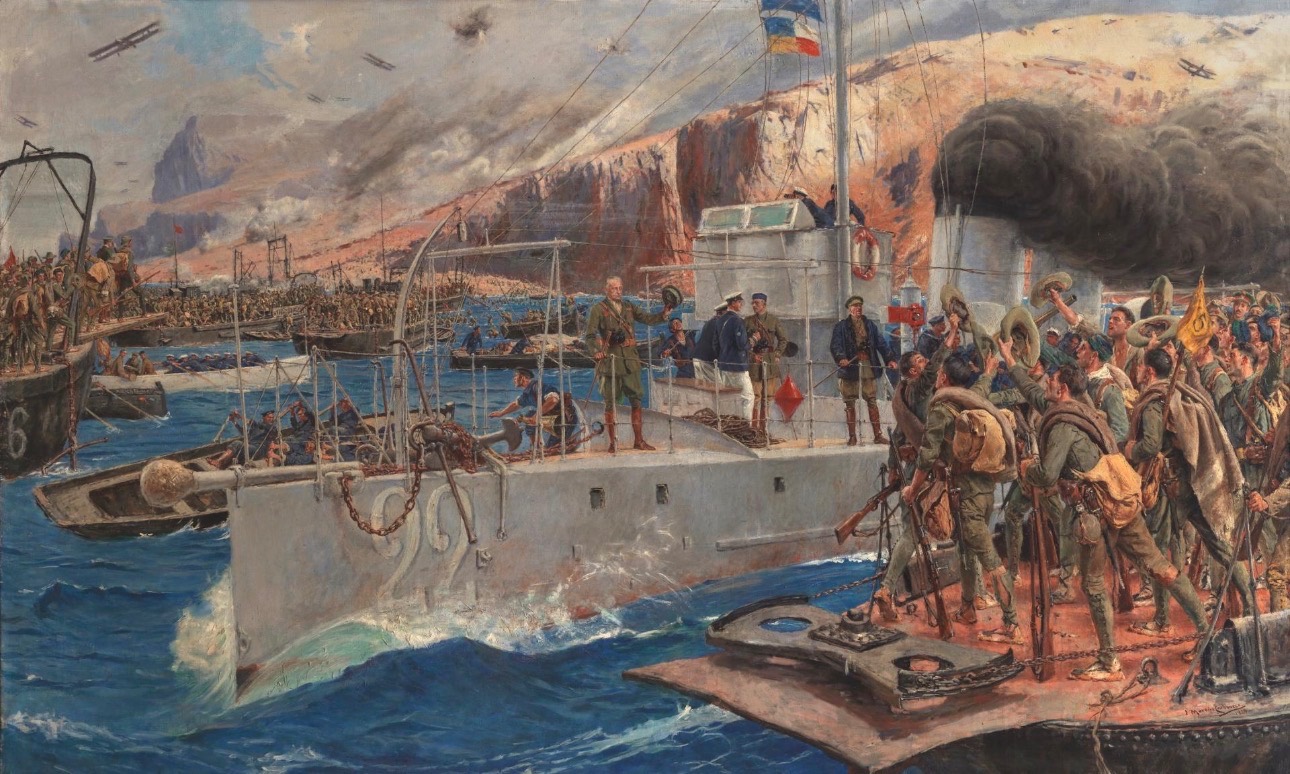
The Alhucemas Landing (1925): A Brief Military Analysis
· By Archivo Bélico editorial team
A brief military analysis of the 1925 Alhucemas landing: the Rif War context, Spanish-French planning, execution and consequences.
The Alhucemas landing, carried out on September 8, 1925, in the bay of the same name on Morocco's northern coast, is one of the most studied amphibious operations of the first half of the 20th century. A Spanish expeditionary force, with French naval and air support, established a beachhead at the heart of the territory of the Republic of the Rif and triggered the campaign that would lead to Abd el-Krim's surrender in 1926.
It should be said plainly from the outset: this article is a brief analysis. There is an extensive body of literature on Alhucemas — military history, colonial history, studies on the use of chemical weapons, participants' memoirs and recent work by Spanish and Moroccan historians — and what follows covers only a small part of everything that has been researched and debated. Its purpose is to orient the reader and point to the sources cited at the end.
The context: from Annual to 1925
The starting point is the Disaster of Annual in July 1921, when the collapse of the Melilla command caused thousands of Spanish deaths and consolidated the power of Abd el-Krim, who proclaimed the Republic of the Rif. Casualty figures vary by source and remain a matter of historiographical debate. In 1924-1925, Miguel Primo de Rivera's military directorate withdrew interior positions to the so-called Estella line and sought a decisive action. The Rif offensive against the French protectorate in spring 1925 prompted cooperation between Spain and France, agreed at the Madrid conference in June of that year.
The planning
Alhucemas Bay was the logical objective — it lies at the center of the territory of the Beni Urriaguel tribe, the base of Abd el-Krim's power — and precisely for that reason it was defended and a foreseeable landing site. The features that military historiography highlights in the planning include:
- Unified command of land, sea and air forces under Spanish direction, with French coordination.
- Use of K-type landing barges, acquired from the United Kingdom and derived from the Gallipoli experience.
- Combined naval gunfire preparation by Spanish and French squadrons.
- Air support with carrier aircraft and seaplanes for reconnaissance and bombing.
- Deception operations to suggest a landing at a different point from the one chosen.
The execution
After delays caused by bad weather, the main landing took place on September 8 on the beaches of the Ixdain and Cebadilla area, in the western sector of the bay, with columns commanded by generals Leopoldo Saro and Emilio Fernández Pérez and units of the Legion and the Regulares in the first wave. Shoals forced part of the troops to wade ashore with water above their waists and delayed the landing of artillery and light tanks. Despite these difficulties, the beachhead was consolidated and the subsequent offensive allowed the capture of Axdir, Abd el-Krim's capital, in early October.
The use of chemical weapons
One aspect documented by historiography and acknowledged in academic work is the use of chemical agents, including mustard gas, by Spanish aviation against Rif population and positions between 1921 and 1927. It is a sensitive matter, with legal and political implications to this day, treated in depth by authors such as Sebastian Balfour, and one this article cannot address with the depth it deserves.
| Element | Detail |
|---|---|
| Date | September 8, 1925 |
| Location | Alhucemas Bay, northern Morocco |
| Forces | Spanish expeditionary forces with French naval and air support |
| Notable innovation | Landing barges and unified land-sea-air command |
| Consequence | Capture of Axdir and surrender of Abd el-Krim in May 1926 |
Why it is studied
Alhucemas is often presented as one of the first modern amphibious operations for its combination of joint command, naval bombardment, air support and dedicated landing assets. Several authors note it was studied with interest by foreign observers and that it anticipates elements of the later development of American and British amphibious doctrine, although the real extent of that influence remains debated and should not be overstated. Politically, the operation bolstered the prestige of the Army of Africa and of Primo de Rivera, with long-lasting consequences for 20th-century Spanish history.
Frequently asked questions
- What was the Alhucemas landing?
- A Spanish-French amphibious operation carried out on September 8, 1925, in Alhucemas Bay, which established a beachhead at the center of Rif territory.
- Why is it considered a modern amphibious operation?
- Because of its unified land, sea and air command, the use of dedicated landing barges, preparatory naval gunfire and coordinated air support.
- Did it end the Rif War?
- Not immediately: it opened the campaign that led to the capture of Axdir in October 1925 and Abd el-Krim's surrender in May 1926.
Sources and references
- Sebastian Balfour, Deadly Embrace: Morocco and the Road to the Spanish Civil War, Oxford University Press, 2002.
- María Rosa de Madariaga, Abd el-Krim el Jatabi: la lucha por la independencia, Alianza Editorial, 2009.
- Juan Pando, Historia secreta de Annual, Temas de Hoy, 1999.
- Pablo La Porte, La atracción del imán: el desastre de Annual y sus repercusiones en la política europea, Biblioteca Nueva, 2001.
- Spanish Ministry of Defense, military history publications on the Morocco campaign
- Revista Ejército, articles on the Alhucemas landing