
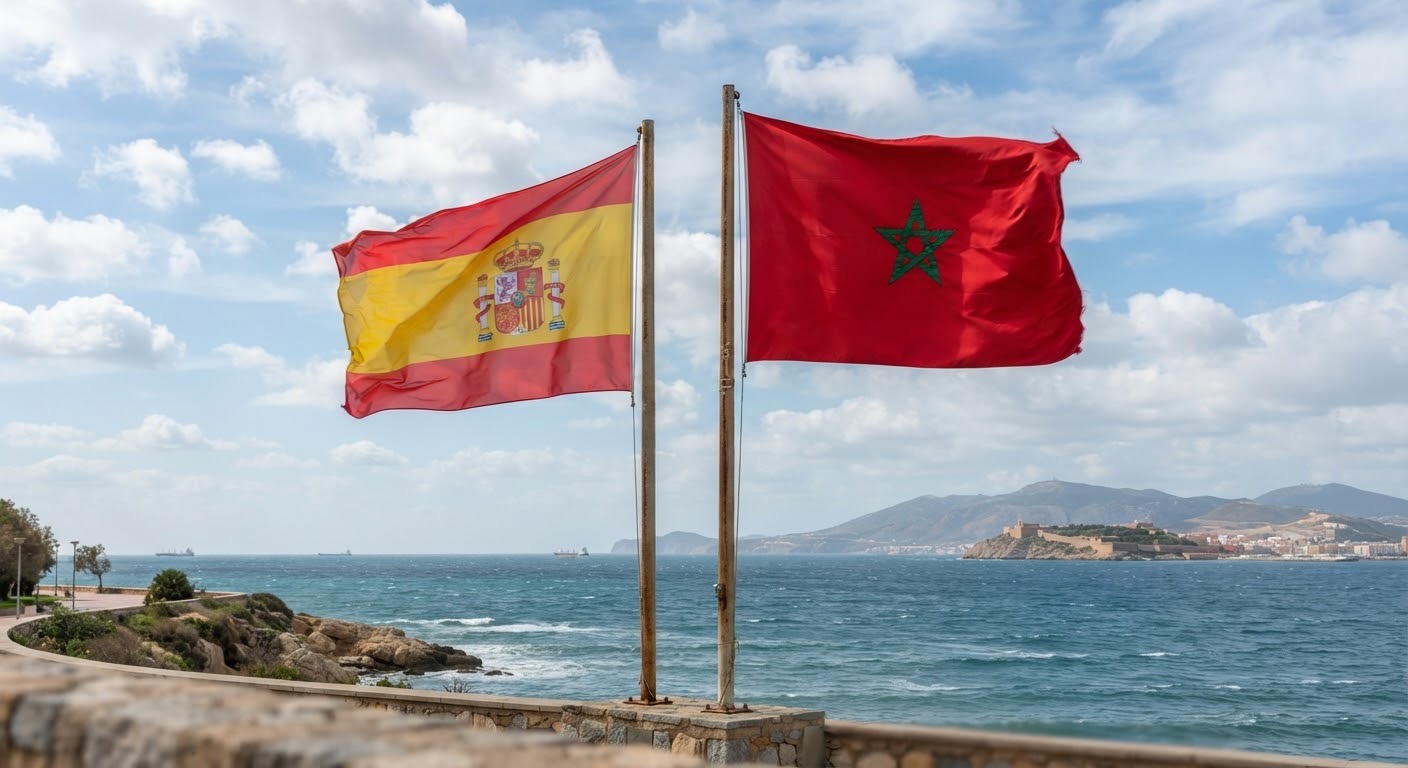
Spain vs Morocco: Strategic Military Strengths Today
· By Archivo Bélico editorial team · Updated
How Spain and Morocco compare today: the Strait of Gibraltar, permanent bases, naval reach, air power, air defence, drones and alliance backing.
Talk of Spanish and Moroccan strongholds tends to conjure ramparts and citadels. In practice, what makes either country strong today is not masonry. It is geography, permanent bases, surveillance reach, fleets, air power and the alliances each can call on. This comparison uses public data to set out where the real strategic and military strength sits on each side of the Strait.
Geography first: the Strait of Gibraltar
The shared strategic asset is the Strait itself: barely 14 kilometres across at its narrowest, carrying one of the densest streams of merchant traffic anywhere and serving as the gateway to the Mediterranean. Neither country can simply close it. The transit passage regime of the United Nations Convention on the Law of the Sea limits what coastal states may do. What confers real weight is the ability to watch, identify and respond to what moves through, and there the two are not equals.
Our guide to the world's most important maritime straits explains why such narrow corridors concentrate so much political and military value.
Spanish strengths: territory, bases and alliance membership
Permanent presence on the southern shore
Ceuta, Melilla and the smaller North African territories are garrisons with permanent units rather than defensive fortresses in the old sense. Their strategic value cuts both ways: they provide stable presence on the southern shore, and they oblige Spain to maintain protection, surveillance and rapid reinforcement there. The Canary Islands add Atlantic depth and a position astride routes towards West Africa.
Bases and shared use
Spain's base network serves national defence and allied commitments alike. Rota, in Cádiz, is a naval base used jointly with the United States and a routine support point for destroyers deployed in Europe; Morón de la Frontera hosts rotational American air presence. That shared use is itself a strength: it turns Spanish geography into infrastructure the wider Alliance depends on.
Naval reach
The Spanish Navy holds a capability Morocco lacks: amphibious shipping and escorts with area air defence. The strategic projection ship Juan Carlos I can operate aircraft and land a force; Álvaro de Bazán-class frigates provide area air defence. Morocco fields a lighter fleet built around surveillance, patrol and coastal defence, with modern frigates but no comparable amphibious or submarine component.
Air power, surveillance and space
Spain pairs Eurofighter and F/A-18 fighters with enablers that matter as much as the aircraft themselves: air-to-air refuelling, strategic transport, maritime patrol and national observation and secure communications satellites. That full chain allows sustained operations at distance, not merely defence of home airspace.
Alliances as a multiplier
NATO and European Union membership is arguably Spain's greatest structural strength, bringing collective defence, shared intelligence, interoperability and access to joint industrial programmes. Morocco is not an Alliance member, but holds major non-NATO ally status with the United States and takes part in cooperation programmes and multinational exercises.
Moroccan strengths: fast modernisation and land mass
A large army with continuous field experience
Morocco's principal strength is on land: sizeable armed forces, permanent deployment in Western Sahara, and accumulated experience in holding ground, field fortification and monitoring a very long defensive line. The berm and obstacle system built in the Sahara is the clearest contemporary example of linear fortification in the region, closer to modern passive defences than to historical fortresses.
Air force and recent acquisitions
Morocco operates upgraded F-16 variants alongside modernised Mirage F1s, and has added guided munitions, surveillance capability and improvement programmes announced publicly through United States foreign military sales notifications. Its air modernisation over the past decade has moved faster in pace than Spain's, though from a smaller technological and industrial base.
Drones and longer-range artillery
Morocco's clearest relative gain lies in uncrewed surveillance and strike systems bought from Turkish, Chinese and Israeli suppliers, and in longer-range rocket artillery. The choice fits the broader trend set out in our piece on the democratisation of violence: capabilities once reserved for great powers now sit within reach of mid-sized budgets.
Air defence and supplier diversification
Rabat has strengthened its air defences with systems of varied origin and has deliberately diversified suppliers, which reduces political dependence while complicating technical integration. Spain maintains integrated air defence built to allied standards, with the interoperability advantage that brings.
| Strategic vector | Spain | Morocco |
|---|---|---|
| Geography | Northern shore of the Strait, Canaries, Balearics | Southern shore, long Atlantic frontage |
| Naval reach | Amphibious and submarine components; escorts with area air defence | Light patrol fleet and modern frigates, no equivalent amphibious arm |
| Combat aviation | Eurofighter and F/A-18 with full enablers (tankers, transport, maritime patrol) | Upgraded F-16s and modernised Mirage F1s, thinner enabler set |
| Uncrewed systems | Surveillance in service, acquisition ongoing | Relative advantage through recent purchases across several suppliers |
| Land mass | Smaller force, oriented to projection and allied commitments | Large army with permanent deployment and field experience |
| Alliances | NATO and EU: collective defence and shared intelligence | Major non-NATO ally of the US; cooperation without collective defence |
| Industrial base | Participation in European defence programmes | Emerging industry, reliant on imports |
What the balance actually means
The comparison does not resolve by adding up equipment. Spain leads on technology, maritime projection, long-range surveillance and, above all, the backing of an alliance with collective defence. Morocco leads on land mass, modernisation tempo and certain specific systems, and enjoys a diplomatic position that lets it buy from several blocs at once. These are strengths of different kinds, which is why no head-to-head tally describes the situation well.
One methodological caution belongs here. Inventories published by institutes such as IISS or SIPRI record declared holdings, not real availability, maintenance, training levels or stockpiled munitions. Those factors are rarely public, and they usually decide more than catalogue figures do.
Frequently asked questions
- Which country is militarily stronger today, Spain or Morocco?
- Their strengths differ: Spain leads in technology, naval projection, surveillance and alliance backing; Morocco in land mass, procurement tempo and some uncrewed and artillery systems.
- Does this article deal with castles or historic walls?
- No. It covers present-day strategic and military strengths: geography, bases, fleets, air power, air defence, surveillance and alliances.
- Can either country close the Strait of Gibraltar?
- Not unilaterally. The transit passage regime under the United Nations Convention on the Law of the Sea limits coastal states' ability to block passage.
- Are Ceuta and Melilla covered by NATO?
- Specialists debate it, because the treaty's geographical scope is disputed as regards North African territories. Spain maintains their defence is both a national and an allied responsibility, with no single settled reading.
- Where do these figures come from?
- From public reference sources: IISS The Military Balance, SIPRI databases, official defence ministry documentation and public United States foreign military sales notifications.
Sources and references
- IISS, The Military Balance 2025, Routledge (Europe and North Africa chapters).
- SIPRI, Military Expenditure Database and Arms Transfers Database (accessed 2026).
- Spanish Institute for Strategic Studies (IEEE), Ministry of Defence: analysis papers on the Strait and the southern flank.
- Spanish Ministry of Defence, National Defence Directive and modernisation programme reports.
- NATO, Defence Expenditure of NATO Countries, annual reports.
- Royal Armed Forces (Kingdom of Morocco) official communications; and U.S. Defense Security Cooperation Agency foreign military sale notifications.
- United Nations Convention on the Law of the Sea (UNCLOS, 1982), regime of passage through straits.