Declassified KGB Manuals: What They Reveal
· By Archivo Bélico editorial team
A historical look at declassified KGB manuals: their origins, authenticity and what they reveal about Soviet intelligence.
Declassified KGB manuals occupy a singular place in the historiography of the Cold War: they are neither spy novels nor journalistic reconstructions, but internal documents — or copies of them — that let us see, from within, how the Soviet Union's principal security and intelligence agency thought and organized itself. Among the most cited is the so-called First Chief Directorate manual, devoted to doctrine on working with human sources, alongside the vast body of notes known as the Mitrokhin Archive. This article reviews what these materials are, how they came to light and how historians assess their value, without going into operational procedures.
The Committee for State Security and its doctrinal apparatus
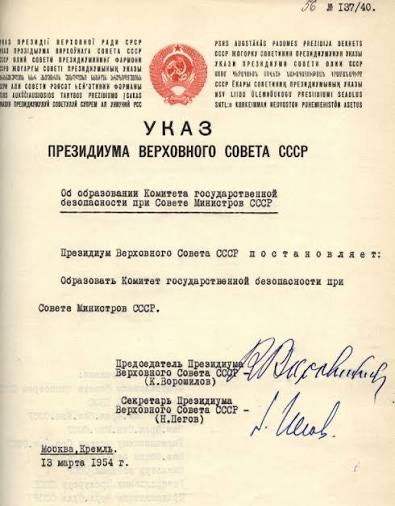
The Komitet Gosudarstvennoy Bezopasnosti (KGB), created in 1954 as heir to the Cheka, the GPU and the NKVD, combined internal political policing with counterintelligence and foreign espionage. The First Chief Directorate (PGU, its Russian acronym) was the branch responsible for foreign intelligence, and it produced manuals, circulars and internal guidelines to train its officers. Written in the bureaucratic language typical of Soviet administration, these texts standardized evaluation criteria, chains of command and doctrinal principles, but they rarely reached anyone outside the apparatus: their declassification or leaking is, in itself, an exceptional historical event.
The Mitrokhin Archive: the most-cited source
The most studied case among academics is that of archivist Vasili Mitrokhin, who worked for almost three decades in the PGU's central archive. Between 1972 and 1984 he hand-copied thousands of notes from case files, which he later hid and, after the dissolution of the USSR, handed over to British intelligence in 1992. The material, catalogued and studied together with historian Christopher Andrew, produced two reference volumes — 'The Sword and the Shield' (1999) and 'The World Was Going Our Way' (2005) — documenting operations, internal structures and priorities of the KGB across decades. These are not operational manuals in the strict sense, but summaries and transcriptions of files; even so, their doctrinal and historical value is enormous because they describe how the organization documented and evaluated its own work.
Other declassified materials
Additional holdings have been declassified by state archives since 1991, such as those of the State Archive of the Russian Federation or materials handed to parliamentary commissions in various countries of the former Soviet sphere, as well as documents obtained by Western services during the Cold War and declassified decades later by agencies such as the CIA as part of historical-review programs. In the United States, the Venona project — the decryption of Soviet communications — offers a complementary but different angle: these are not manuals but intercepted communications.
What they reveal about the KGB's organizational culture
Beyond specific episodes, what these documents allow historians to reliably reconstruct is the institutional culture of Soviet intelligence: an obsession with bureaucratic control, written accountability to superiors, centralization of decisions in Moscow, and the coexistence of an official ideology with pragmatic personnel-management criteria. Historians stress that the KGB functioned as a hierarchical, highly formalized organization in which every action had to be recorded in a file — a trait that, paradoxically, is precisely what has since allowed its history to be reconstructed in such detail.
- Centralization of doctrine in specialized directorates (PGU for foreign intelligence, Second Chief Directorate for internal security).
- A culture of case files and written evaluation of each officer and source.
- Coexistence of stated ideological aims with pragmatic management criteria.
- Strong compartmentalization of information between departments.
- Institutional continuity with the Cheka, the GPU and the NKVD despite changes of name and era.
The authenticity debate
As with any intelligence source, academics have subjected these materials to careful scrutiny. In Mitrokhin's case, historians such as Christopher Andrew defended the archive's reliability by cross-checking it against independent sources — from judicial investigations to statements by other defectors — though it has also been noted that the notes were taken from memory or copied hastily over the years, which introduces possible transcription errors. Other documents circulating online as supposed "KGB recruitment manuals" lack verifiable archival provenance and are treated by specialists with skepticism, since neither their chain of custody nor their real documentary origin has been established.
| Source | Origin | Nature | Academic assessment |
|---|---|---|---|
| Mitrokhin Archive | Copied by Vasili Mitrokhin (1972-1984), handed over in 1992 | Notes and transcriptions of PGU case files | Widely cited, cross-checked with other sources |
| Venona Project | Decryption of Soviet communications by the US and UK | Intercepted communications, declassified from 1995 | High technical reliability, limited context |
| Post-Soviet state archives | Declassified after 1991 in various national archives | Administrative and personnel documents | Variable, depending on the specific holding |
| Alleged "recruitment manuals" circulating online | Unverified origin | Texts with no clear archival provenance | Academic skepticism, no chain of custody |
Why this debate matters today
Interest in these manuals is not merely antiquarian. Understanding how the KGB documented and organized its work helps historians and contemporary analysts grasp the institutional continuity of today's Russian services, direct heirs of that bureaucratic culture, and helps them critically weigh the sources that circulate about historical intelligence. In an information ecosystem saturated with documents of dubious origin presented as "leaks," the methodological discipline of academic historiography — cross-checking sources, analysing provenance, caution toward the unverifiable — remains the only reliable way to separate historical fact from spy myth.
Frequently asked questions
- Is there a single, authentic and publicly accessible "KGB recruitment manual"?
- No single document of that kind exists with fully verified archival provenance and general public access. What does exist are notes, files and academic studies — such as the Mitrokhin Archive — that document KGB doctrine and organization through sources cross-checked by historians.
- What is the Mitrokhin Archive?
- It is the body of handwritten notes that archivist Vasili Mitrokhin copied over nearly three decades working in the KGB's First Chief Directorate archive and handed over to British intelligence in 1992, forming the basis of several reference books on Soviet intelligence.
- Are the documents circulating online as KGB manuals reliable?
- Most lack verifiable archival provenance, so historians treat them with caution unless they can be cross-checked against recognized archival holdings or serious academic research.
- What's the difference between the Mitrokhin Archive and the Venona project?
- The Mitrokhin Archive consists of notes taken by a Soviet archivist from inside the KGB; Venona is an Anglo-American program that decrypted intercepted Soviet communications. Both are complementary but differ in nature and origin.
Sources and references
- Christopher Andrew and Vasili Mitrokhin, 'The Sword and the Shield', Basic Books, 1999
- Cambridge Intelligence Seminar — profile of Christopher Andrew
- National Security Archive, George Washington University — KGB collections
- CIA, Venona Project — Historical Documents
- BBC History — 'The Mitrokhin Archive'
- Wilson Center Digital Archive — Cold War International History Project