
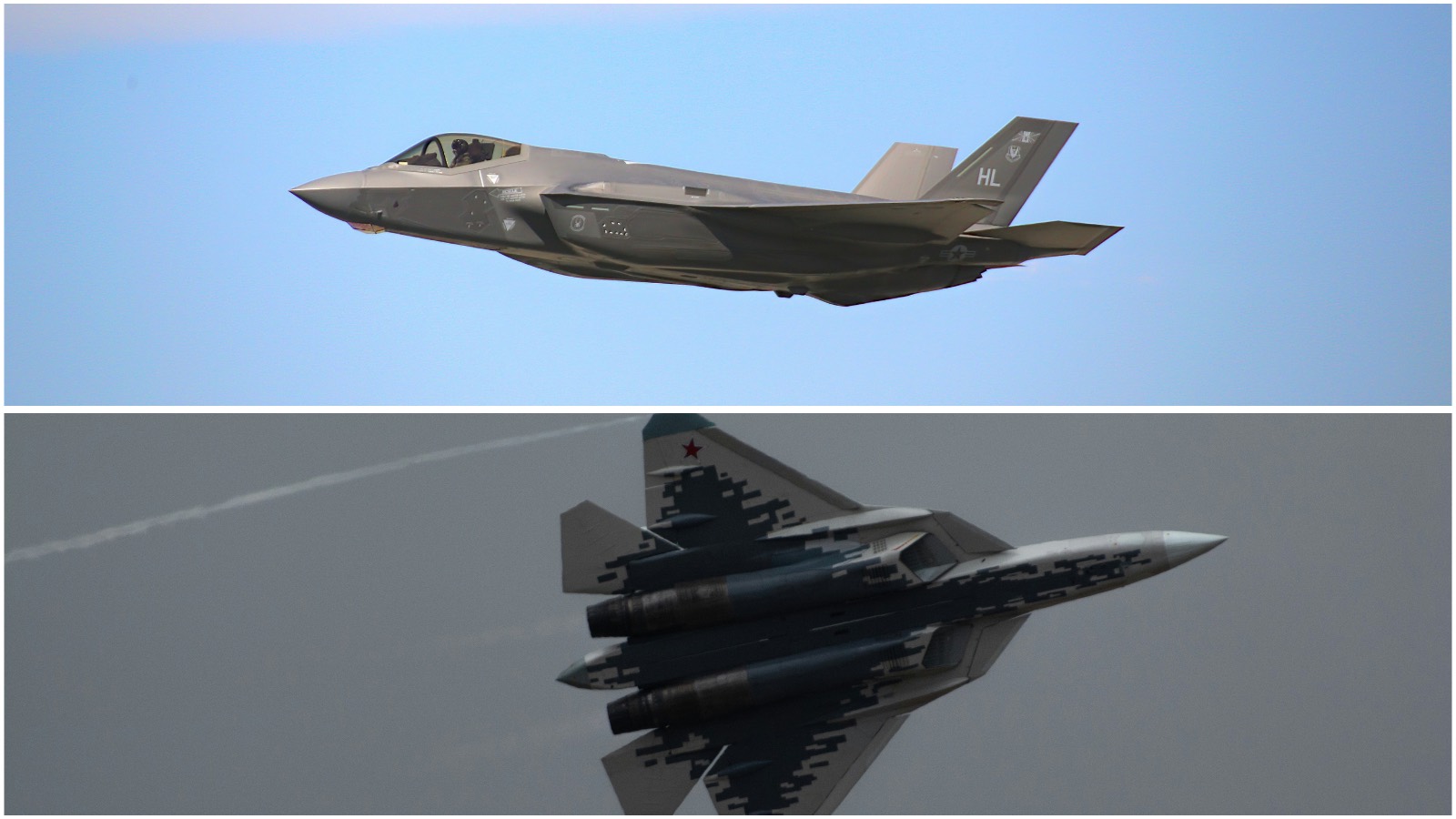
F-35 vs Su-57: Fifth-Generation Fighters Compared
· By Archivo Bélico editorial team · Updated
F-35 vs Su-57 compared: stealth, sensors, engines, production numbers and combat use of the two fifth-generation fighters, based on public data and sources.
Which is better, the F-35 or the Su-57? In short, they are built to win in different ways. America's F-35 Lightning II is a multirole fighter designed first and foremost as a stealthy sensor platform, built in large numbers and flown by around twenty countries. Russia's Su-57 favours speed, agility and range, but has only been produced in small numbers. This F-35 vs Su-57 comparison sets out the differences using public data.
The F-35 vs Su-57 in a nutshell
- F-35: carefully shaped stealth, sensor fusion and networking; top speed and agility are not its priority.
- Su-57: a large twin-engine design built for high speed and supermanoeuvrability; most Western analyses judge its radar signature to be larger.
- The biggest practical gap is scale: thousands of F-35s planned against a few dozen Su-57s delivered.
F-35 vs Su-57 comparison table
| Feature | F-35A | Su-57 |
|---|---|---|
| Manufacturer | Lockheed Martin (US) | Sukhoi / UAC (Russia) |
| First flight | 2006 | 2010 |
| Engines | 1 (F135) | 2 (AL-41F1; new Izdeliye 30 in testing) |
| Stated top speed | ≈ Mach 1.6 | ≈ Mach 2 |
| Units delivered | Over 1,000 | A few dozen (estimate) |
| Operators | About 20 countries (incl. orders) | Russia; one export customer reported (Algeria) |
Stealth and sensors: where the F-35 leads
The F-35 was designed around a very low radar signature, with internal weapons bays, aligned surfaces and dedicated coatings. Its other strength is sensor fusion: it merges radar, distributed infrared sensors and electronic warfare into a single picture and shares it across the network.
The Su-57 also has internal bays and low-observable features, but Western analysts point to details such as its air intakes and visible panel joints that increase its signature. Russia maintains the aircraft meets its requirements. Without comparable official data, the exact radar cross-section of either jet remains an estimate.
Speed and manoeuvrability: the Su-57's strengths
With two engines and thrust-vectoring nozzles, the Su-57 is built for high-speed, high-altitude combat and extreme manoeuvres. The single-engine F-35 trades some of that performance for stealth and internal payload. Western doctrine is about seeing and shooting first rather than winning a dogfight.
Production, cost and combat use
According to the US Government Accountability Office (GAO), the F-35 is the most expensive weapons programme in US history, and the GAO has also documented readiness and sustainment problems. It has nonetheless flown combat missions with Israel and the United States.
Russia's defence ministry says the Su-57 has been used in a limited role in Syria and in the war in Ukraine, mainly launching stand-off weapons from Russian airspace. Ukraine claimed to have damaged one on an airfield in 2024. Series production has been slow, partly because of sanctions.
Verdict by mission: when each one wins
- Penetrating modern air defences and striking unseen: the F-35, thanks to all-aspect stealth and sensor fusion.
- Fast interception at high altitude and manoeuvring air combat: the Su-57, with its speed, ceiling and thrust-vectoring nozzles.
- Networked operations with allies and a shared tactical picture: the F-35, by a wide margin, through its data architecture and the Western support fleet.
- Unit cost and autonomy from sanctions: the Su-57, although its actual production remains very limited.
The jet matters less than the system around it: early warning, tankers, satellites and missiles decide more than any specification sheet.
A recurring synthesis in RUSI and IISS analysis of modern air combat
So which fighter is better?
It depends on the mission and, above all, on the system behind the aircraft: tankers, airborne early warning, satellites and weapons. Fighters do not fight alone. On public information, the F-35 leads on stealth, sensors, networking and numbers, while the Su-57 leads on speed and agility. Anything more definitive goes beyond what open sources support.
For the debate over the F-35's technological dependence, read about the F-35 kill switch rumour; for Russian air defence, see our S-300 comparison.
Frequently asked questions
- Is the F-35 stealthier than the Su-57?
- Most open-source analyses say yes, though exact radar signature figures are not public.
- Which jet is faster?
- The Su-57, with a stated top speed close to Mach 2 against the F-35's Mach 1.6.
- How many Su-57s exist?
- There is no official figure; public estimates put deliveries at a few dozen.
Sources and references
- IISS, The Military Balance 2025.
- U.S. Government Accountability Office (GAO), reports on the F-35 programme (2023-2024).
- Lockheed Martin, official F-35 fact sheets.
- United Aircraft Corporation and Russian Ministry of Defence statements on the Su-57.
- Justin Bronk, analysis of Russian air power, Royal United Services Institute (RUSI).